Artificial Intelligence
The Wrong Question About AI in Education
A Johns Hopkins Socratic tutor built on GPT-4o refused to hand students answers. Only 15% of their messages demanded one anyway, and their exam scores were no better than the control group's.
- Published
- August 18, 2026
- Licence
- CC BY 4.0
A couple days ago, I was scrolling through Instagram Reels when I came across a young entrepreneur sharing how she made an astonishing amount of money. Her business? One AI source writes the script, another source turns it into a fully animated video (with cartoons, narration, characters), then finally, it gets posted on a platform for children without a human touching even a single editing software. Surely this had been a joke – do kids even watch these videos? To my surprise, they sure do. These AI children’s channels attract hundreds of millions of views without end, posting new videos every day. The simplest low-effort input had generated a massive amount of traction. Leave it to Gen Z to find a way to turn an AI-epidemic into something so lucrative. But underlying the absurdity is a bigger question: what happens to the generation raised on content that requires nothing from them at all?
You’ve read or heard it dozens of times: the impact of AI is binary for children. It’s EITHER rotting children’s minds OR unlocking their full potential. We ought to choose a side, cite a study, and move on. And maybe it’s easier for us to digest the black-and-white opinion over a study that just says “it depends.”
But truthfully, those versions are getting stale, and worse, it’s getting at the wrong question. The question shouldn’t be, again, whether generative AI helps or harms children’s learning. It’s what children expect AI to do in the first place and what those expectations reveal now that AI is in full-effect in classrooms.
In late 2025, a research team at Johns Hopkins – one of the first to actually test how kids used AI instead of speculating about it – embedded a large language model (LLM) into a 3-week summer course on the human body and medicine for gifted 7th-10th grade students (testing about two grade levels ahead of their peers). Another group took the same course without the AI-helper. 22 students were split into two groups: members of the AI group averaged about 13 years old and was 82% female, and those of the control group averaged about 14 years old and was 55% female. Though it was a smaller sample size and not randomized, the students picked their own section. In a way, this study mimicked that of a college class, not a lab, where kids opted into the course voluntarily in addition to their regular schooling.
The chatbot was engineered deliberately. It was designed as a Socratic tutor, named Dr. Smith, built on OpenAi’s GPT-4o and on the logic that handing students correct answers teaches them nothing. Instead of confirming or denying a diagnosis, Dr. Smith role-played as an instructor, asked follow-up questions, encouraged students to explain their reasoning, and prompted them to reflect on what evidence supported their conclusions. When students simply asked for answers, it refused and redirected the conversation.
The outcome was surprising: almost none of the students tried to demand mere answers. Only 15% of student messages were blatant requests for the solution. Over 50% of all interactions were actually requests for background information such as symptoms, definitions, raw materials, and then students would use their own reasoning to answer. Looking at their final grades, students using the AI tutor performed no better on the final exam than those in the traditional course. Researchers often worry that LLMs encourage overreliance and passive learning. But this study suggests that students didn’t fail to benefit because the chatbot was poorly designed. Instead, they failed because of a mismatch in expectations. The gap existed between what the AI tutor was built to do and what students assumed a responsive system was for.
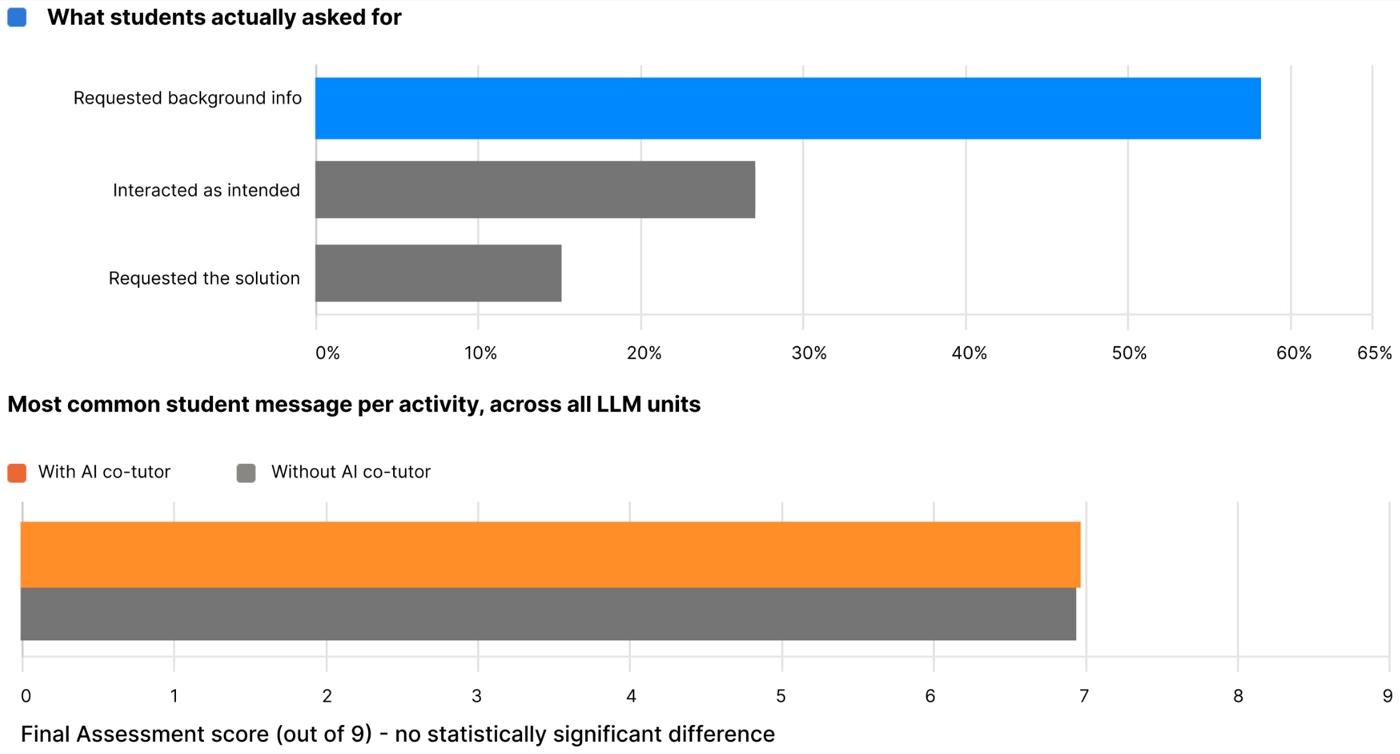
Figure 1. Top: the most common student message per activity, across all LLM units. Requests for background information accounted for roughly 58% of messages, interactions of the kind the tutor was designed for about 27%, and blatant requests for the solution about 15%. Bottom: final assessment scores out of 9, showing no statistically significant difference between students with and without the AI co-tutor.
We often ask whether AI changes the way children think and learn. But what if many children had already decided what a responsive digital system was supposed to do, long before they encountered this study? Years of search engines and instant information from algorithms could likely condition not only them, but also us to believe that asking a question produces a low-effort answer. Let’s be honest. If ChatGPT refused to summarize the middle eight Books of the Iliad, you’d simply glitch.
For middle and high school students, getting help shouldn’t mean eliminating the need to participate. A tool can hand them information without doing their thinking for them, but the struggle, the reflection, and the wait are all supposed to still be within the agency of the student. Maybe AI isn’t even the main issue–rather, it is what we’ve spent years transactionally expecting from technology. If that’s true, the fix won’t ever be the next best, most powerful chatbot. It’s teaching the youth, explicitly, how to redirect it into a system meant for tangible learning.
References
- Thompson, K. N., Chandler, K. L., Morgan, C., Khashabi, D., Delinski, E. A., & Van Durme, B. (2025). Artificial intelligence as a co-tutor: Assessing the impact in the advanced learning virtual classroom. Journal of Advanced Academics, 36(4), 714–745. https://doi.org/10.1177/1932202X251356323
How to cite this article
Choi, S. (2026). The Wrong Question About AI in Education. Columbia Scientist, Summer Publishing Program. https://columbiascientist.org/articles/wrong-question-ai-education
© 2026 Sua Choi. This is an open-access article distributed under the terms of the Creative Commons Attribution 4.0 International licence, which permits use, distribution, and reproduction in any medium, provided the original author and source are credited.