Medicine
Running Towards the Sting
People have used bee and wasp venom as medicine since the 19th century. Melittin, most of bee venom's active content, appears to suppress the cytokines that inflame rheumatoid arthritis.
- Published
- August 18, 2026
- Licence
- CC BY 4.0
As children, we’ve been told to “bee” wary (pun intended) of flying insects with stingers. Not only does the sting itself hurt, but once the venom enters the body, the area can be inflamed for days. Worst case scenario, a person with an allergy to the venom can cause severe reactions like anaphylaxis. That said, people have been using honeybee venom therapy (BVT) since the 19th century in Egypt, Greece, Korea, and China and Vespa Magnifica wasp venom (VMWV) found in Yunnan, China’s Jingpo region to treat a multitude of diseases. The most common use of these treatments is for patients with musculoskeletal diseases like Rheumatoid Arthritis (RA).
RA is an autoimmune condition where the increase in the number of synovial cells, the lubricating fluid found between joint bones, forms antibodies that begin to attack the tissue lining of joints and slowly decays the underlying bone. The pain attributed with RA is caused by cytokines like the tumor necrosis factor (TNF-α), interleukin-6 (IL-6), interleukin-1β (IL-1β) (Jang D.) Normally, cytokines are produced in recognition of antigens, foreign objects. However, in an autoimmune disorder like RA, the immune system misrecognizes body-made particles as an antigen. After constant erosion, the joint becomes deformed, reducing its functionality and mobility. Currently, there is no cure for RA, but the pain can be managed through two main treatments. The first are nonsteroidal anti-inflammatory drugs (NSAIDs) which first inhibit cyclooxygenase 1 and 2 (COX-1 and COX-2) enzymes, thus inhibiting the production of prostaglandins, the moderators of inflammation. The other type are disease-modifying antirheumatic drugs (DMADs) which target the immune system directly by weakening it to silence its response. However, NSAIDs may result in stomach irritation, as prostaglandins protect the inner stomach lining from gastric acid, while DMADs allow the patient to become more susceptible to other diseases without any defense barrier from their immune system to support them (Johns Hopkins). While there are many other drugs on the market alleviating RA-associated pain, almost all of them have notable side effects.
So what’s so great about purposefully getting stung?
Melittin, a protein that comprises 50%-60% of bee venom’s active ingredients, possesses many anti-inflammatory properties. As a monomer in low concentrations, melittin is toxic and can disrupt the lipid bilayer of a cell leading to a cell’s death. But in combination with other components, it forms a tetramer that can stabilize and regulate inflammation. While scientists aren’t sure of the mechanics behind it, melittin has shown to “downregulate phospholipase A2 (PLA2), cyclooxygenase (COX-2), and TNF-α expression while reducing levels of IL-1β, IL-6, nitric oxide (NO), and reactive oxygen species (ROS)” (Pareek). Additionally, melittin has been shown to decrease osteoclast production by interfering with the RANKL-RANK signaling pathway and IL-1β which prevents bone degradation (Choe). Multiple anti-coagulant, immunosuppressant, anti-platelet, and anti-inflammatory compounds have been separated from VMWV, and in 2020, it was shown that the venom treatment had inhibited IL-6, TNF-α, and IL-1β levels in animal models with collagen II induced arthritis, and thus successfully reduced the inflammation caused by RA (Gao).
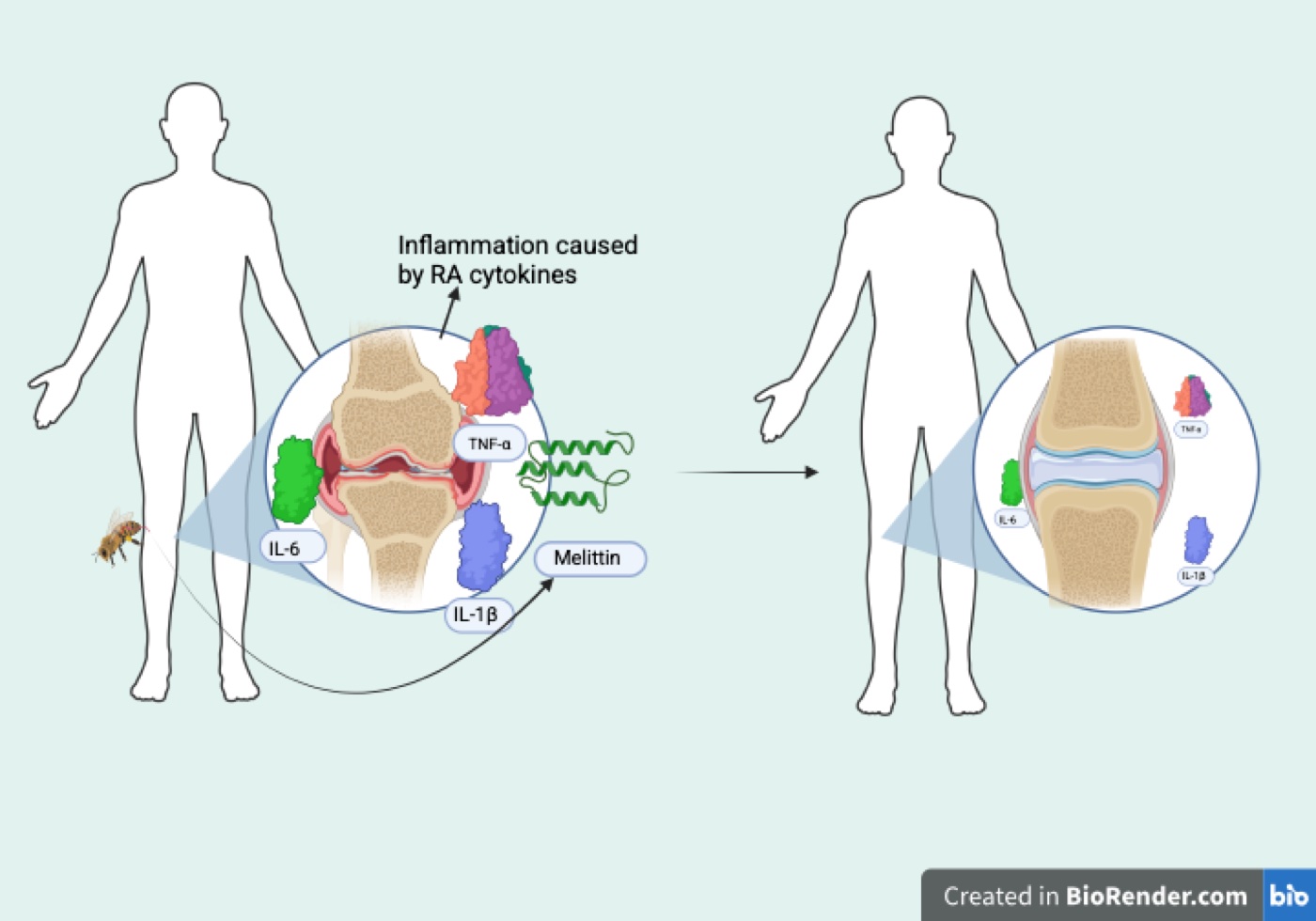
Figure 1. Melittin, delivered by a honeybee sting, counters the cytokines that drive rheumatoid arthritis. On the left, TNF-α, IL-6, and IL-1β inflame the knee joint; on the right, the same joint after melittin reduces those cytokine levels.
Still, this therapy has many downsides despite its affordability. Patients with allergies to bee and wasp venom are primarily susceptible to the melittin, hyaluronidase, and PLA2 components, and thus would suffer from anaphylaxis rather than gain any actual relief. Additionally, not enough research and data has been conducted and found to truly prove if this is a safe and viable option compared to the approved therapies on the market (Jang S.). Lastly, this medicine is not cruelty-free requiring the death of multiple honeybees to attain an adequate dose seeing as water comprises 88% of the venom.
Today, scientists are also finding new uses for venom therapies in addition to their research on its benefits for RA. Further research on the separation of venom components present possible therapies for breast cancer, parkinson’s disease, multiple sclerosis, lyme disease, and amyotrophic lateral sclerosis (ALS) in addition to having anti-microbial, anti-viral and anti-diabetic properties. So the next time you get stung, you just might be able to skip your next doctor’s appointment. Unless you’re deathly allergic. Then, no. Please go see a doctor.
References
- Choe, J.-Y., & Kim, S.-K. (2017). Melittin inhibits osteoclast formation through the downregulation of the RANKL-RANK signaling pathway and the inhibition of interleukin-1β in murine macrophages. International Journal of Molecular Medicine, 39(3), 539–548. https://doi.org/10.3892/ijmm.2017.2876
- Gao, Y., Yu, W.-X., Duan, X.-M., Ni, L.-L., Liu, H., Zhao, H.-R., Xiao, H., Zhang, C.-G., & Yang, Z.-B. (2020). Wasp Venom Possesses Potential Therapeutic Effect in Experimental Models of Rheumatoid Arthritis. Evidence-Based Complementary and Alternative Medicine, 2020(1). https://doi.org/10.1155/2020/6394625
- Jang D., Lee, A.-H., Shin, H.-Y., Song, H.-R., Park, J.-H., Kang, T.-B., Lee, S.-R., & Yang, S.-H. (2021). The Role of Tumor Necrosis Factor Alpha (TNF-α) in Autoimmune Disease and Current TNF-α Inhibitors in Therapeutics. International Journal of Molecular Sciences, 22(5). https://doi.org/10.3390/ijms22052719
- Pareek A., Mehlawat K., Tripathi, K., Pareek A., Chaudhary, S., Ratan Y., Apostolopoulos, V., & Chuturgoon A. (2024). Melittin as a therapeutic agent for rheumatoid arthritis: mechanistic insights, advanced delivery systems, and future perspectives. Frontiers in Immunology, 15. https://doi.org/10.3389/fimmu.2024.1510693
- Jang S., & Kim, K. H. (2020). Clinical Effectiveness and Adverse Events of Bee Venom Therapy: A Systematic Review of Randomized Controlled Trials. Toxins, 12(9), 558. https://doi.org/10.3390/toxins12090558
- Rheumatoid Arthritis Treatment Options. (n.d.). In Johns Hopkins Arthritis Center. Retrieved July 31, 2026, from https://www.hopkinsarthritis.org/arthritis-info/rheumatoid-arthritis/ra-treatment/#hydroxy
How to cite this article
Garlapati, M. (2026). Running Towards the Sting. Columbia Scientist, Summer Publishing Program. https://columbiascientist.org/articles/bee-wasp-venom-rheumatoid-arthritis
© 2026 Monika Garlapati. This is an open-access article distributed under the terms of the Creative Commons Attribution 4.0 International licence, which permits use, distribution, and reproduction in any medium, provided the original author and source are credited.