Disease
Disrupting Dystrophinopathies: The Road to Answers
Muscular dystrophy affects 1 in 5,000 to 10,000 people, so it rarely gets discussed. A former MDA camp counselor walks through the dystrophinopathies and the therapies now chasing a cure.
- Published
- August 18, 2026
- Licence
- CC BY 4.0
I remember the drive to my first week as a counselor at the Muscular Dystrophy Association’s NJ summer camp. As I got closer and dark green trees filled my window, my heart began to beat faster and faster. Thoughts swarmed in my head: How will I know how to take care of someone with muscular dystrophy? What if I do something wrong?
I hadn’t even heard of muscular dystrophy before applying to be a counselor.
Muscular dystrophy (MD) is classified as a “rare” disease, as it affects only 1 in 5,000 to 10,000 people (LaPelusa, 2023). Because of this, MD is not discussed frequently, even in many medical settings, and is often at the brunt of funding cuts affecting scientific research. MD may be rare, but every single person is made up of muscles, from the ones that make our heart pump to the ones that make our toes wiggle. By researching what goes wrong to cause muscle wasting, we learn something about the anatomy of each of us who roam this planet.
I am not the right person to give you a full picture of muscular dystrophy: you would need to turn to someone living with MD for that. However, I do know the power of talking about diseases that get sidelined. Through this article, I will give you a peek into muscular dystrophy’s most common form: the dystrophinopathies.
Each muscle in our body is made up of fibers. A protein called dystrophin attaches to these fibers, supporting them and absorbing shock from the constant motion they endure. Linking the fibers to the cell’s cytoskeleton, dystrophin looks and acts like a tethering rope.
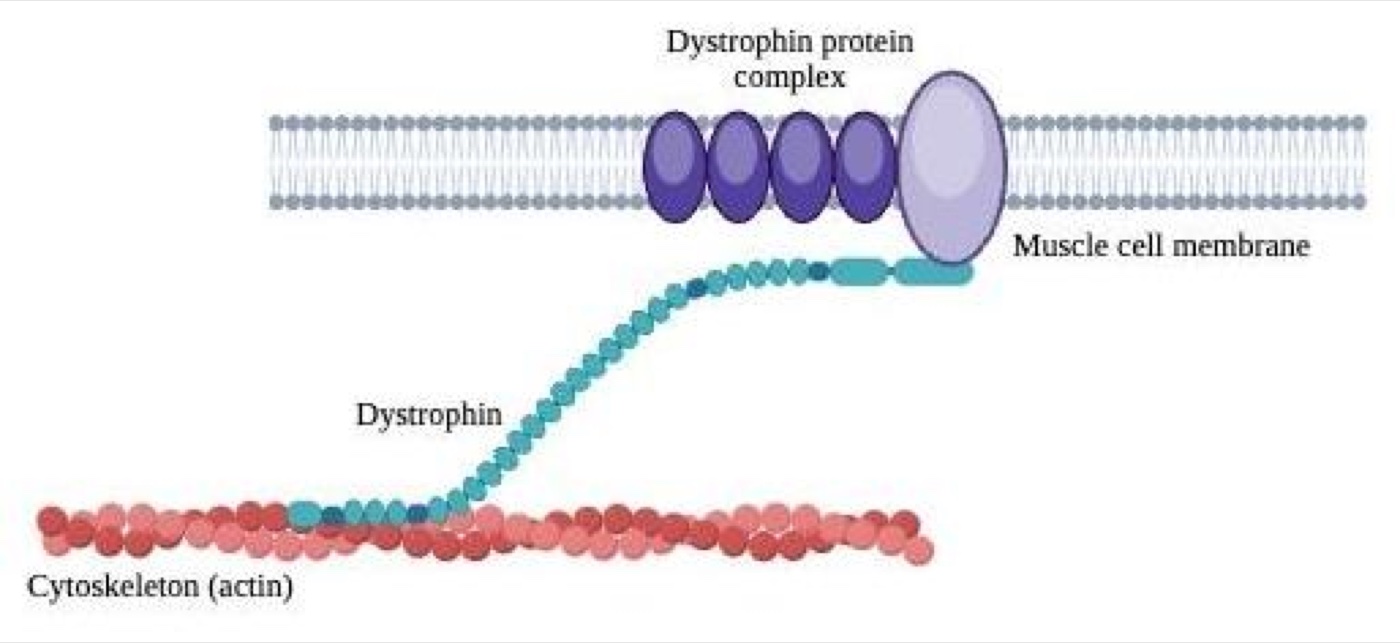
Figure 1. Dystrophin works like a tethering rope: it links the actin cytoskeleton inside a muscle fiber to the dystrophin protein complex embedded in the muscle cell membrane.
Dystrophinopathies are caused by mutations in the DMD gene, which provides instructions to make the dystrophin protein. Our genes are made up of sequences of code, and when they contain a mistake, it is called a mutation. The DMD gene is in fact the largest human gene! Unfortunately, because the sequence is especially long, there is more room for error (Jayaraman, 2025).
The gene that codes for dystrophin is on the X chromosome. Males have one X chromosome and one Y chromosome, while females have two X chromosomes. Thus, dystrophinopathies are much less common in females than males because in females, one X chromosome can code for a functional dystrophin protein, even if the other chromosome has a mistake and cannot. The most common type of dystrophinopathy is Duchenne Muscular Dystrophy, which affects 1 in 5,000 boys and is severely progressive: children often stop being able to walk before their teens. Another type of dystrophinopathy is Becker Muscular Dystrophy (BMD), which is a milder form of MD: the dystrophin protein is still produced, but it doesn’t work perfectly (Muscular Dystrophy Association, 2018).
For a long time, the main treatment for dystrophinopathies was corticosteroids, which help prevent muscle inflammation and breakdown. Yet, steroids often cause problems for patients, including weight gain and stunted growth. Not to mention, even with steroids, the life expectancy for Duchenne Muscular Dystrophy patients is devastatingly only into their late 20s to early 30s (Muscular Dystrophy Association, 2018).
In recent years, scientists have developed new treatments for these diseases. One class of these drugs is called micro-dystrophins. Micro-dystrophins borrow the outside shell of a tiny, non-disease-causing virus called an adeno-associated virus (AAV) and place a correct dystrophin gene in it. The virus shells are inserted into the patient’s body via an IV and enter the muscles throughout their body (Jayaraman, 2025; Miller, 2023).
Another class of drugs is called exon-skipping therapies. All genes are made up of sections called exons, similar to the different pages of an instruction manual. Exon-skipping therapies use short sticky molecules called antisense oligonucleotides, which can cover the mRNA produced from the dystrophin gene that has a mistake. With exon-skipping therapies, cells can’t make a perfect dystrophin protein, but they can make one that works much better than before. If patients with Duchenne Muscular Dystrophy are treated with exon-skipping therapies, scientists and doctors hope that their disease will present more like the less severe Becker Muscular Dystrophy (Jayaraman, 2025; Takeda, 2021).
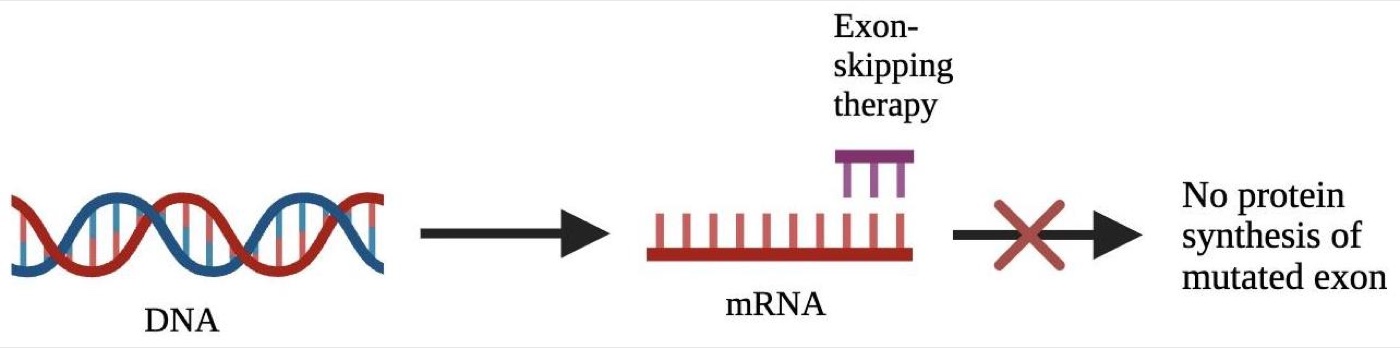
Figure 2. Exon-skipping therapy in action. A short antisense oligonucleotide binds the mRNA transcribed from the DMD gene and masks the faulty exon, so the mutated section is skipped rather than translated into protein.
These two drugs are not perfect. There can be life-threatening immune responses with micro-dystrophins, and the body may not even make enough good dystrophin with exon-skipping therapies (Katarzyna, 2022; Miller, 2023). Scientists are continuing to look for ways to not only treat dystrophinopathies, but cure them. Many labs and biotech companies are looking towards CRISPR gene editing to remove the mutated DMD gene and replace it with a functional one (Chemello, 2023).
Our understanding of dystrophinopathy has a very long way to go. At the same time, research in muscular dystrophy has led to major strides in understanding human muscle anatomy: scientists didn’t even know that our muscles contained dystrophin until studying dystrophinopathy (Hoffman, 2020).
I’m now preparing for my second summer at MDA camp and my first summer as a cabin leader. In many ways, I feel the same as I did driving up to camp my first year. Nervous of the unknown. The difference is that now I know I have my fellow counselors and campers to help when I feel stuck. Whether you are a counselor caring for kids at camp or a researcher studying the intricacies of dystrophin, the road forward will always be a continuous stream of questions and a perpetual pursuit of answers.
References
- LaPelusa, A., & Kentris, M. (2023). Muscular Dystrophy. In PubMed. StatPearls Publishing. https://www.ncbi.nlm.nih.gov/books/NBK560582/
- Jayaraman, D., & Ghosh, P. S. (2025). Dystrophinopathies. Continuum, 31(5), 1462–1485. https://doi.org/10.1212/cont.0000000000001618
- About Duchenne Muscular Dystrophy - Parent Project Muscular Dystrophy. (2017). In Parent Project Muscular Dystrophy. https://www.parentprojectmd.org/about-duchenne/
- Katarzyna Chwalenia, Jacopo Oieni, Zemła, J., Małgorzata Lekka, Ahlskog, N., Coenen-Stass, A. M., McClorey, G., Wood, M. J., Yulia Lomonosova, & Roberts, T. C. (2022). Exon skipping induces uniform dystrophin rescue with dose-dependent restoration of serum miRNA biomarkers and muscle biophysical properties. Molecular Therapy. Nucleic Acids, 29, 955. https://doi.org/10.1016/j.omtn.2022.08.033
- Chemello, F., Olson, E. N., & Bassel-Duby, R. (2023). CRISPR-Editing Therapy for Duchenne Muscular Dystrophy. Human Gene Therapy, 34(9–10), 379–387. https://doi.org/10.1089/hum.2023.053
- Continuum. (2025, November 26). Dystrophinopathies With Dr. Divya Jayaraman. YouTube. https://www.youtube.com/watch?v=IU8iB2VYdtk
- Hoffman E. P. (2020). The discovery of dystrophin, the protein product of the Duchenne muscular dystrophy gene. The FEBS journal, 287(18), 3879–3887. https://doi.org/10.1111/febs.15466
- Miller, A. (2023, April 19). Micro-dystrophin: A Small Gene With Big Promise – Pediatrics Nationwide. Pediatricsnationwide.Org; Pediatrics Nationwide. https://pediatricsnationwide.org/2023/04/19/micro-dystrophin-a-small-gene-with-big-promise/
- Muscular Dystrophy Association. (2018). Duchenne Muscular Dystrophy (DMD). In Muscular Dystrophy Association. https://www.mda.org/disease/duchenne-muscular-dystrophy
- Muscular Dystrophy Association. (2018). Becker Muscular Dystrophy (BMD) | Muscular Dystrophy Association. In Muscular Dystrophy Association. https://www.mda.org/disease/becker-muscular-dystrophy
- Muscular Dystrophy Association. (2018). Duchenne muscular dystrophy (DMD) - medical management. In Muscular Dystrophy Association. https://www.mda.org/disease/duchenne-muscular-dystrophy/medical-management
- Takeda, S., Clemens, P. R., & Hoffman, E. P. (2021). Exon-Skipping in Duchenne Muscular Dystrophy. Journal of Neuromuscular Diseases, 8(s2), S343–S358. https://doi.org/10.3233/JND-210682
How to cite this article
Bressler, D. (2026). Disrupting Dystrophinopathies: The Road to Answers. Columbia Scientist, Summer Publishing Program. https://columbiascientist.org/articles/disrupting-dystrophinopathies-road-to-answers
© 2026 Dania Bressler. This is an open-access article distributed under the terms of the Creative Commons Attribution 4.0 International licence, which permits use, distribution, and reproduction in any medium, provided the original author and source are credited.