Physics and Space
Where's Waldo(s)?
Fritz Zwicky proposed dark matter in 1933. Nobody has ever detected it, and the newest models suggest the reason is that physicists have been hunting one particle instead of three.
- Published
- August 18, 2026
- Licence
- CC BY 4.0
In 1933, Swiss astronomer Fritz Zwicky noticed something strange: galaxies within the Coma Cluster were moving incredibly fast. So fast that they should have torn apart from each other. He realized that without “dark matter” holding these galaxies together, every textbook containing Newton’s theories of gravitation and centripetal acceleration would have to be torn to pieces; as many physics students across the world can attest, though, these textbooks have stubbornly endured, just as the Coma Cluster has endured for billions of years.
Introduction
Today, Zwicky’s assumption forms our understanding of galactic dynamics, but one problem remains: we’ve never observed dark matter. The chase to detect this elusive substance has consumed theoretical physicists for decades, and the answer may lie in a sub-atomic particle: the neutrino.
If You Fail, Try, Try Again!
At first, scientists proposed a single dark matter particle, but much like Democritus’s model of a solid, indivisible atom, it was never that simple.
Using the LUX-ZEPLIN, an underground particle detector, attempts were made to detect the movement of xenon nuclei as dark matter scattered off them [1]. Here, scientists tested the single-component fermion doublet model, a theory proposing one stable dark matter particle [1]. They believed that a Z-boson, a heavy sub-atomic particle, could be used to exchange forces during dark matter and nuclei collisions [1,2]. Because these sub-atomic interactions are invisible to the naked eye, scientists analyzed a cross sectional area between 10⁻⁴³ centimeters squared and 10⁻⁴¹ centimeters squared in their 2024 experiment [1]. They were certain these cross sections were large enough to observe many nuclei interactions as the Z-boson scattered [1]. Shockingly, though, no recoil signals from the nuclei were observed, forcing the scientists to concede that dark matter was not solely composed of fermion doublets [1].
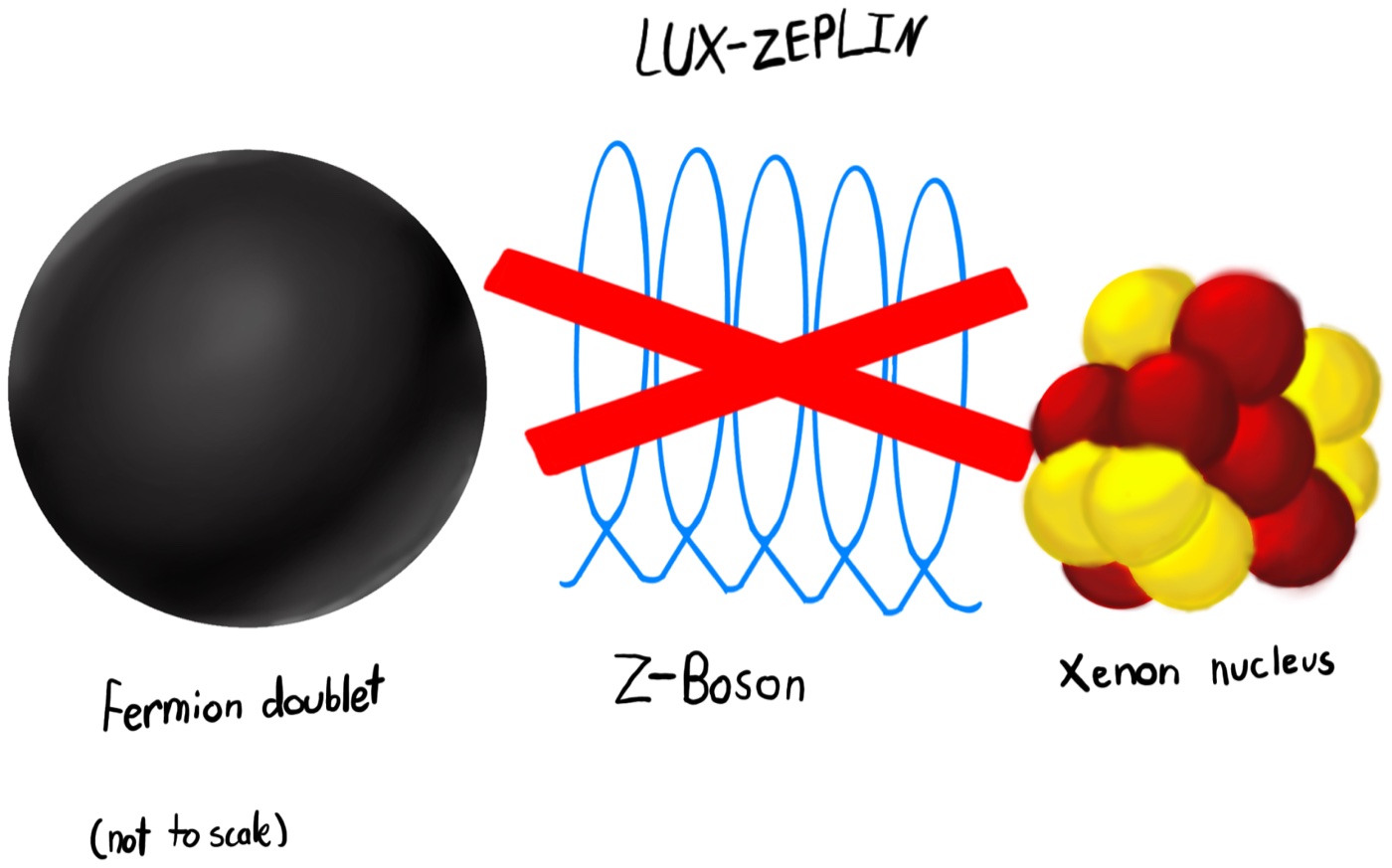
Figure 1. Inside the LUX-ZEPLIN detector, no Z-boson was exchanged between the fermion doublet and the xenon nuclei, so no recoil signal ever appeared.
Essentially, imagine you stayed in a room where even a single wasp, if present, would likely sting you (trust me, don’t worry). After waiting for twenty-four hours, you walk through the door unscathed. This serves as evidence that there were no wasps present to begin with. Similarly, even with a low concentration of Z-bosons, the fermion doublet would have triggered a reaction that resulted in the collision of xenon nuclei, revealing that a lack of activity eliminates this fermion as a dark matter candidate [1].

Figure 2. The wasp analogy: spending twenty-four hours in a room and walking out unstung is evidence that no wasp was there to begin with.
After attempting to figure out why the predicted scattering rate varied so widely with the experiment’s lack of detections, scientists suggested that the fermion doublet acquired a Majorana mass [1]. Scientists hypothesized that the fermions used in the experiment would split into two pseudo-Dirac states, or two nearly identical Majorana fermions with the ability to self-annihilate, since they are their own antiparticles [1]. Interestingly, Majorana fermions will annihilate during elastic collisions because they will attempt to occupy the same space [1]. However, the Z-boson may only scatter when these Majorana fermions elastically collide into each other [1,2]. This fits perfectly into the framework of the LUX-ZEPLIN experiment, as the scientists maintained the velocity of the dark matter at 650 kilometers per second, explaining that no Z-bosons were scattered because the fermion doublet did not acquire enough kinetic energy to split into Majorana fermions and collide elastically [1,2].
Eureka!
Except for one problem. Although this model agreed with the experiment, it would not explain the abundance of dark matter in our universe today [1]. Dark matter in galaxies travels so fast that nearly all of it would self-annialate, so the scientists were sent back to their drawing boards.
However, a phoenix rose through the ashes of these unvalidated theories, ready to settle the score: the triplet scalar.
Found At … Last?
Remember that neutrino? See, under the Standard Model of physics, it should be a massless sub-atomic particle, except in every experiment scientists have run, the opposite is true [3]. That’s where the triplet scalar comes in. The triplet scalar is a field of three hypothetical components, consisting of one neutral particle and two charged particles [1,4]. This field is influenced by the weak force, one of the four fundamental forces of the universe [1,4,7].
Once this electroweak symmetry breaks, though, the triplet scalar occupies a vacuum expectation value, which is the lowest energy state a field can exist in [1,4,6]. Quickly, the triplet scalar pairs to leptons, a family of subatomic particles that include neutrinos, and the vacuum expectation value generates Majorana masses for neutrinos [1,4,6]. This process, called a type II seesaw mechanism, explains why experimentally observed neutrinos have mass [3,6]!
What about the dark matter model? Well, through this process, the generated mass makes it possible for the fermion doublet to split into pseudo-Dirac states [1]. This clarifies the origin of the hypothesized Majorana fermions in the LUX-ZEPLIN experiment while explaining the lack of Z-boson interactions [1].
One question remains: why is dark matter so abundant in the universe?
So far, the leading candidate has been the inert scalar doublet: a stable pair of Higgs scalar fields that do not alter the mass of regular matter particles [1,5,7]. Scientists believed it still aligns with the LUX-ZEPLIN’s lack of activity because they only interact with particles by exchanging Higgs bosons, which are hidden from detection during experiments [1,5,7]. Their suspicions laid to rest, though, when they compared their results with the PLANCK satellite [1]. The PLANCK satellite measured the cosmic microwave background to determine the density of dark matter across the universe [1]. Amazingly, when the theoretical densities of the inert scalar doublet and the fermion doublet predicted by the two-component dark matter model were summed, they matched the dark matter density from the PLANCK satellite [1]! Therefore, scientists have strong evidence to suggest the fermion doublet must be complemented by the triplet scalar and the inert scalar doublet to reflect satellite observations.
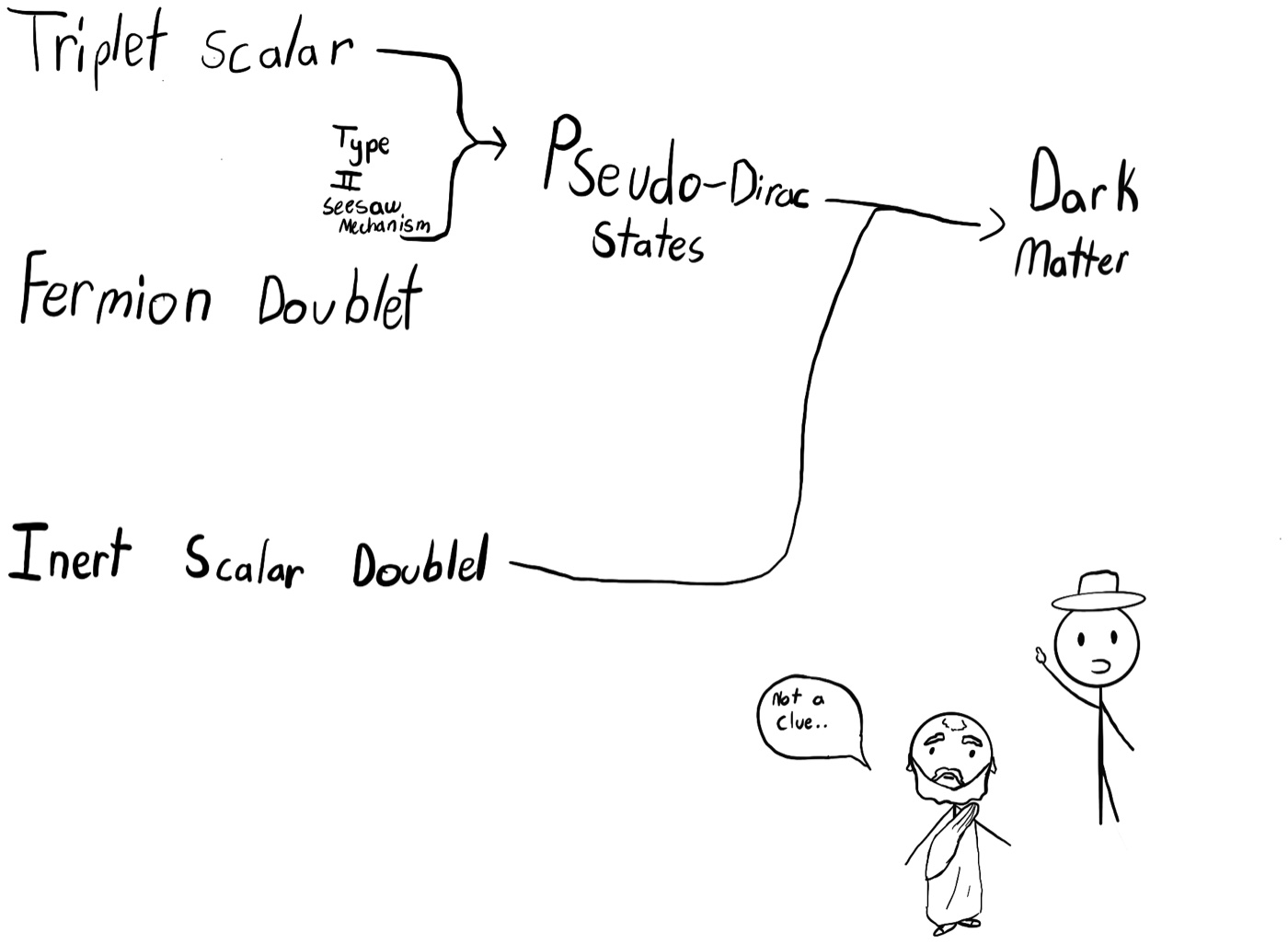
Figure 3. The two-component picture: the triplet scalar and the fermion doublet combine through a type II seesaw mechanism to produce pseudo-Dirac states, which together with the inert scalar doublet account for dark matter.
You Can Finally Rest!
The failures of the one-particle model are what propelled scientists to search for a clear understanding of dark matter’s origin in our universe. Until recently, scientists believed they were playing an extremely small game of Where’s Waldo; funnily enough, these scientists were required to bend the rules and search for three Waldos in a slew of sub-atomic particles and fields. Although we may never truly “detect” dark matter particles, I’m sure Zwicky is either smiling from his grave or rolling over it.
References
- Frank M, Ghosh P, Majumdar C, Senapati S. Exploring two component doublet dark matter. Phys Rev D. 2025;112(5):055014. doi:10.1103/3sxl-lf71.
- The Z boson – Home | CERN [Internet]. Geneva: CERN; 2025 [cited 2026 Aug 15]. Available from: https://home.cern/science/physics/z-boson/.
- Kruppke D. On theories of neutrino oscillations: a summary and characterisation of the problematic aspects [diploma thesis]. 2007 Sep [cited 2026 Aug 15]. Available from: https://s3.cern.ch/inspire-prod-files-a/a46f60e4c743094086e02710760c0dae.
- Arbeláez C, González M, Hirsch M, Neill NA, Restrepo D. Effective field theory and scalar triplet dark matter. J High Energy Phys. 2025;2025(4):118. doi:10.1007/JHEP04(2025)118.
- Arias C, Martins J, Martinez H, Ron E, Salzmann C, Vasconcelos GMS, et al. The inert doublet model [presentation]. Latin American School of High Energy Physics; 2009 [cited 2026 Aug 15]. Available from: http://physicschool.web.cern.ch/LatAmSchool/2009/Presentations/pDG2.pdf.
- Butterworth J, Heeck J, Jeon SH, Mattelaer O, Ruiz R. Testing the scalar triplet solution to CDF’s heavy W problem at the LHC. Phys Rev D. 2023;107(7):075020. doi:10.1103/PhysRevD.107.075020.
- Sahu R. Probing the inert doublet dark matter with stellar-mass black hole mini-spikes [preprint]. 2026 [cited 2026 Aug 15]. Available from: https://arxiv.org/abs/2605.07616.
How to cite this article
Kazazi, P. (2026). Where's Waldo(s)?. Columbia Scientist, Summer Publishing Program. https://columbiascientist.org/articles/wheres-waldos-dark-matter
© 2026 Parid Kazazi. This is an open-access article distributed under the terms of the Creative Commons Attribution 4.0 International licence, which permits use, distribution, and reproduction in any medium, provided the original author and source are credited.