Disease
How Long Can An Epidemic Last?
37% of Bundibugyo Ebola survivors report symptoms lasting two years or longer. With cases surging in the Democratic Republic of Congo, the illness may outlast the outbreak.
- Published
- August 18, 2026
- Licence
- CC BY 4.0
The way that we are taught to think of most curable illnesses is fairly simple. You contract the illness in question, receive treatment, take antibiotics or whatever form of medication you need to take, and, for the most part, don’t have to worry about it ever again. This may not be the case for Ebola.
Ebola disease is primarily caused by one of three different viruses within the orthoebolavirus family: Zaire Ebola virus, Sudan virus, and Bundibugyo virus. Orthoebolaviruses are a genus of viruses that cause hemorrhagic fevers; in other words, multi-organ system failure. Ebola disease as a whole has a 50% fatality rate, but this fatality rate differs by strain or virus. Zaire Ebola virus itself is the most common, as well as being the deadliest strain with a 90% fatality rate; meanwhile, Bundibugyo virus, the most recently discovered orthoebolavirus strain, has the lowest fatality rate at around 30%.
While Bundibugyo has appeared to be a less deadly form of Ebola disease, recent research has found that it has far more long-term health impacts than other strains.
According to a study published in the Lancet medical journal, upon follow-up examinations of a group of survivors, researchers found that many survivors of Bundibugyo Ebola virus experienced further symptoms around two weeks to two months after disease onset. These symptoms included impaired hearing and blurred vision, impacting 27% and 39% of Ebola survivors compared to 10% and 17% of non-infected participants respectively. Worse still, 37% of survivors reported symptoms lasting two years or longer, and many respondents reported that post-Ebola complications, such as joint pain, fatigue, and muscle weakness, caused difficulty functioning on a day-to-day basis and at work.
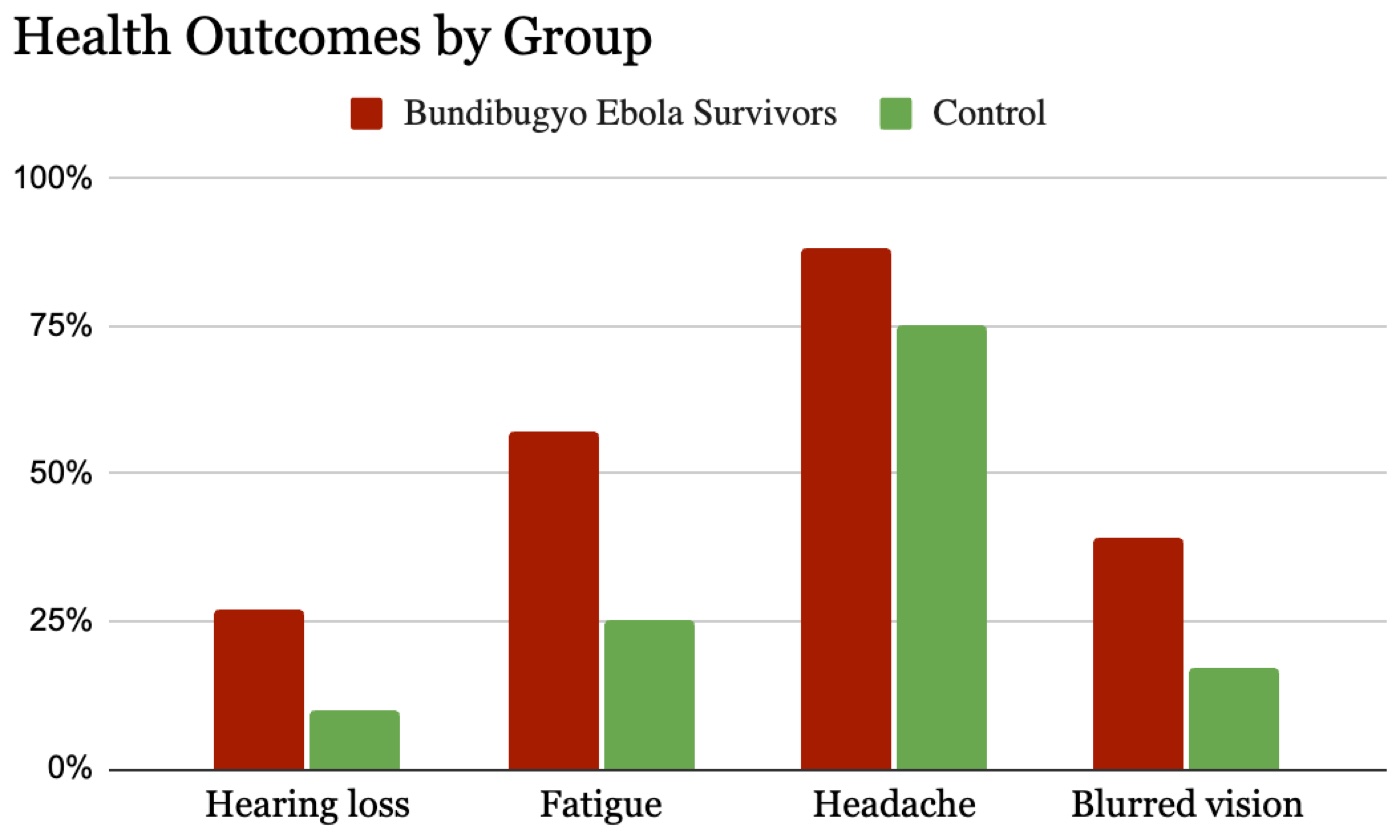
Figure 1. Health outcomes by group: self-reported symptoms among Bundibugyo Ebola survivors compared with uninfected controls. Hearing loss affected 27% of survivors versus 10% of controls, and blurred vision 39% versus 17%.
Long-term impacts of Ebola disease are not limited to the Bundibugyo strain. A previous 2020 study published in Nature documented how Ebola caused long-term tissue damage and, while survivors didn’t report the same impact to their daily lives, survivors also experienced symptoms pointing to weaker immune systems. Specifically, researchers observed that, on top of experiencing tissue damage, the cells of survivors showcased markers of inflammation and that their T-cells, used by our immune systems to fight off infections, behaved irregularly in comparison to those who had not contracted Ebola; researchers also concluded that this immune dysfunction needs to be researched further to determine whether or not Ebola is connected to chronic illnesses. With regards to longevity of symptoms, while the survivors in this study were not followed up on, symptoms also appeared to continue at minimum months from initial infection.
What only makes the researchers findings more relevant is the fact that Bundibugyo Ebola virus is currently seeing a major resurgence in central Africa. In May 2026, an outbreak of Bundibugyo Ebola virus was declared in the Democratic Republic of Congo and has since been further straining the nation’s already suffering medical infrastructure, with over a thousand deaths declared thus far. The Democratic Republic of Congo is currently in the midst of a civil war waged by Rwandan-backed armed terrorist group M23, which has caused the displacement of over eight million people, primarily internal displacements and mostly in eastern DRC, where the Ebola virus has also taken hold. So far, nearly 1,500 have died due to the virus and cases have only continued to rise, particularly in mining towns with higher population density (the fact that these regions are crucial for Congolese industry makes the potential chronic-nature of symptoms more of a national concern).
Further research still needs to be conducted on what this research could mean for medical professionals moving forward and for Ebola treatment. With these findings alongside the rise in Bundibugyo Ebola in DRC, though, there is cause for concern as to what this rise in cases will mean for the country in later years. Even if fatalities are kept low and many of those infected survive, will Congolese public health authorities be able to handle the possible rise in Ebola-caused chronic conditions in later years (something they have not tackled as of yet)? Only time (and further research) will tell.
References
- Ali, Faisal. 2026. “Ebola Deaths in DRC Surge Past 1,300 as Virus ‘Spreading like a Wildfire.’” Al Jazeera, July 25, 2026. https://www.aljazeera.com/news/2026/7/25/ebola-deaths-in-drc-surge-past-1300-as-virus-spreading-like-a-wildfire.
- Center for Disease Control. 2024. “About Viral Hemorrhagic Fevers.” In Viral Hemorrhagic Fevers (VHFs). https://www.cdc.gov/viral-hemorrhagic-fevers/about/index.html.
- Center for Disease Control. 2024. “Ebola Outbreak History.” In Viral Hemorrhagic Fevers. https://www.cdc.gov/ebola/outbreaks/index.html.
- Clark, Danielle V, Hannah Kibuuka, Monica Millard, Salim Wakabi, Luswa Lukwago, Alison Taylor, Michael A Eller, et al. 2015. “Long-Term Sequelae after Ebola Virus Disease in Bundibugyo, Uganda: A Retrospective Cohort Study.” The Lancet Infectious Diseases 15 (8): 905–12. https://doi.org/10.1016/s1473-3099(15)70152-0.
- Ngorora, Prosper Heri. 2026. “Ebola Outbreak in DRC the Fastest Growing in the History of the Virus.” The Guardian, July 31. https://www.theguardian.com/global-development/2026/jul/31/ebola-outbreak-in-drc-the-fastest-growing-in-the-history-of-the-virus.
- United Nations High Commissioner for Refugees. 2024. “DR Congo Emergency.” In Unhcr. https://www.unhcr.org/emergencies/dr-congo-emergency.
- United Nations Security Council. 2020. “M23 | Security Council.” In UN Sanctions List Materials. https://main.un.org/securitycouncil/en/sanctions/1533/materials/summaries/entity/m23.
- World Health Organization. 2025. “Ebola Disease.” In Who.Int. World Health Organization: WHO. https://www.who.int/news-room/fact-sheets/detail/ebola-disease.
How to cite this article
Demir, V. (2026). How Long Can An Epidemic Last?. Columbia Scientist, Summer Publishing Program. https://columbiascientist.org/articles/chronic-ebola-symptoms
© 2026 Vernon Demir. This is an open-access article distributed under the terms of the Creative Commons Attribution 4.0 International licence, which permits use, distribution, and reproduction in any medium, provided the original author and source are credited.