Food Science
Cell-Cultured Meat: A Sustainable Alternative?
The first lab-grown burger cost $330,000 in 2013. Cultured meat now runs $17 to $20 a pound, uses 99% less land than livestock, and is banned in Florida.
- Published
- August 18, 2026
- Licence
- CC BY 4.0
Earlier this year, the state of Florida banned cell-cultured meat, in a ruling dubbed “another loss for Frankenmeat.”[1] Similar bans of the lab-grown alternative have started to gain traction around the country, drawing attention to the burgeoning industry.
Cell-cultured meat, also known as lab-grown or cultivated meat, was first unveiled in 2013. Culminating decades worth of research, scientists from Maastricht University, produced a single $330,000 burger. Critics claimed it tasted “close to meat” and that “the general bite feels like a hamburger.”[2] Despite these unconvincing first impressions, the unveiling was described as a “very good start,” introducing what has now become a multi-billion dollar industry. Recent years, however, have seen increased lobbying, regulatory action, and public scrutiny, slowing growth.
There exist real concerns about the viability of cultured meat as a sustainable alternative. To better understand the ongoing argument, we must first understand the benefits of cultured meat and the process through which it is developed.
‘Meat Without Slaughter’
Raising livestock is incredibly inefficient. Producing just one calorie of beef requires feeding a cow 20-25 calories of crops, which is why over 80% of all farmland today is devoted to the production of feed.[3] Demand for meat has led to habitat destruction and biodiversity loss, as farms replace natural ecosystems which trap CO2 and serve as homes for countless species.
Livestock also produce large amounts of methane, a potent greenhouse gas that traps heat much more efficiently than carbon dioxide. Livestock accounts for ~30% of methane emissions globally, which is why studies have proposed phasing out meat production entirely to reduce greenhouse gas emissions.[4] Instead of feeding crops to animals, these crops could be consumed directly, reducing land use and allowing for the recovery of ecosystems. Researchers estimate that phasing out animal agriculture would provide 52% of the emission reductions necessary to avoid disastrous climate change.[5]
Of course, entirely phasing out meat consumption is unlikely, which is where cultured meat comes in. Cultured meat involves only growing edible tissue itself, rather than raising an entire animal and then slaughtering it. This offers both moral and environmental benefits. Cultured meat production uses over 80% less water and 99% less land than livestock farming, while producing no methane emissions.[6]
‘Frankenmeat’
Manufacturing cultured meat begins with the extraction of animal stem cells—undifferentiated cells that have the potential to develop into a variety of tissues. Once extracted, these stem cells are grown in bioreactors, or chambers that sustain a nutrient-rich environment. The composition of this environment is altered to cue differentiation into the components of meat: skeletal muscle, fat, and connective tissue.
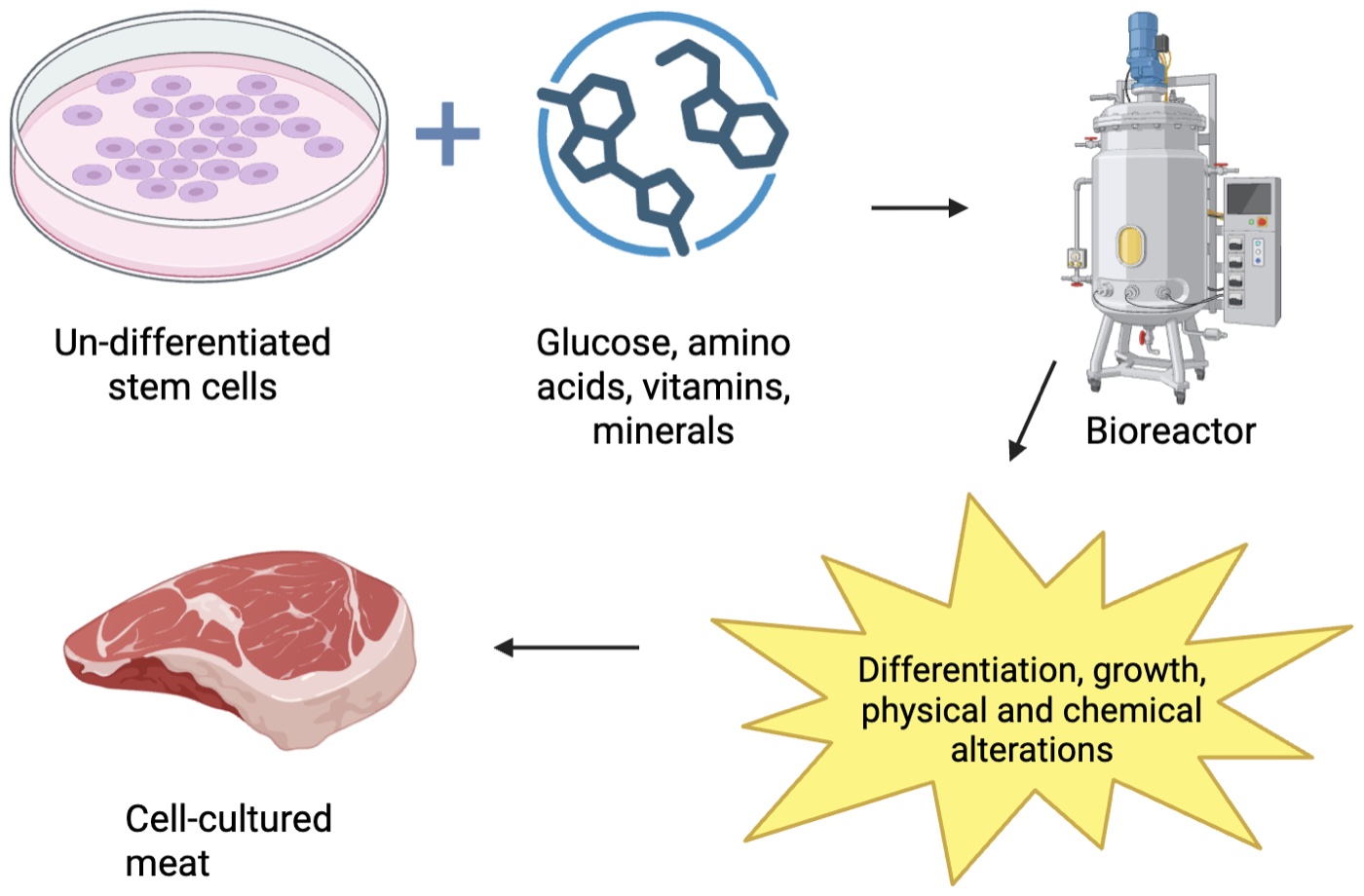
Figure 1. How cell-cultured meat is made: undifferentiated animal stem cells are combined with a nutrient medium of glucose, amino acids, vitamins, and minerals, grown in a bioreactor, and then differentiated and physically and chemically altered into cell-cultured meat.
Stem cells are bound to scaffold structures, which help them grow in specific ways. Muscle cells, for example, adhere to scaffolds that encourage the formation of myofibers, or muscle fibers, which give meat its normal texture.[7] Scaffolding is imperfect, making it hard to replicate the complex texture of a steak, for example. A variety of physical and chemical techniques are used to enhance taste, appearance, and nutritional value before the final product is ready.
The pharmaceutical-like production of cultured meat, which takes place in a lab and involves a variety of synthetic chemicals, has prompted skepticism. Research on long-term consumption is limited, though one study found that cultured meat contains lower levels of nutrients, including protein, and higher levels of fat and cholesterol.
Cultured meat producers argue that factory farms are also nothing like the healthy natural farm environments many imagine their meat comes from. Factory farmed animals often have physiological issues that translate to low quality meat. Cheap feed, for example, leads to inflammation in livestock, which results in meat with higher levels of unhealthy inflammatory fats.[8]
A Long Way to Go
Despite its promises, cell-cultured meat remains a novelty. Prices sit around $17-20 per pound, compared to $7-8 for regular beef, making it a specialty item at higher-end restaurants.[9] Experts suggest, however, that upscaling in manufacturing will make production more efficient, driving prices down.
Additionally, research in the field of regenerative medicine may translate into improved meat. Novel scaffolds made of biological polymers that help with the regrowth of human bone and muscle tissue could be applied to create meat with more natural texture, for example. Ultimately, the future of cultured meat relies on public acceptance and scientific advancements that make it more commercially viable. The next few years will reveal if people turn to this ‘frankenmeat’ as a tasty, yet climate-conscious alternative, or reject it in favor of entirely plant-based options.
References
- [1] “Florida’s ban on lab-grown meat upheld by federal appeals court in ‘another loss for Frankenmeat,’” Mar. 2026. Accessed: Aug. 16, 2026. [Online]. Available: https://www.cbsnews.com/miami/news/federal-appeals-court-upholds-floridas-ban-on-lab-grown-meat-protecting-states-real-food-law/
- [2] “World’s First lab-grown Burger Is Eaten in London,” BBC News, Aug. 05, 2013. Accessed: Aug. 16, 2026. [Online]. Available: https://www.bbc.com/news/science-environment-23576143
- [3] “Disrupting Meat,” Oct. 2016. Accessed: Aug. 16, 2026. [Online]. Available: https://cbey.yale.edu/our-stories/disrupting-meat
- [4] B. O. Manono, “Methane Emissions from Livestock Operations: Sources, Sinks, and Mitigation Strategies,” Methane, vol. 5, no. 1, p. 7, Feb. 2026, doi: 10.3390/methane5010007.
- [5] K. Than, “New model explores link between animal agriculture and climate change,” Feb. 2022. Accessed: Aug. 16, 2026. [Online]. Available: https://news.stanford.edu/stories/2022/02/new-model-explores-link-animal-agriculture-climate-change
- [6] A. Quinton, “Lab-Grown Meat’s Carbon Footprint Potentially Worse than Retail Beef,” UC Davis, May 2023. Accessed: Aug. 16, 2026. [Online]. Available: https://www.ucdavis.edu/food/news/lab-grown-meat-carbon-footprint-worse-beef
- [7] S. Soleymani, S. M. Naghib, and M. R. Mozafari, “An overview of cultured meat and stem cell bioprinting: How to make it, challenges and prospects, environmental effects, society’s culture and the influence of religions,” Journal of Agriculture and Food Research, vol. 18, p. 101307, July 2024, doi: 10.1016/j.jafr.2024.101307.
- [8] J. Anomaly, “What’s Wrong With Factory Farming?,” Public Health Ethics, vol. 8, no. 3, pp. 246–254, Feb. 2014, doi: 10.1093/phe/phu001.
- [9] A. Driver, “Opinion: Lab-grown meat is an expensive distraction from reality,” July 2023. Accessed: Aug. 16, 2026. [Online]. Available: https://www.cnn.com/2023/07/05/opinions/lab-grown-meat-expensive-distraction-driver
How to cite this article
Talla, N. (2026). Cell-Cultured Meat: A Sustainable Alternative?. Columbia Scientist, Summer Publishing Program. https://columbiascientist.org/articles/cell-cultured-meat-sustainable-alternative
© 2026 Naveen Talla. This is an open-access article distributed under the terms of the Creative Commons Attribution 4.0 International licence, which permits use, distribution, and reproduction in any medium, provided the original author and source are credited.