Artificial Intelligence
How AI is Helping Scientists Make Discoveries in Battery Science
Screening 32 million candidate battery materials would have taken a human team decades. A Pacific Northwest National Laboratory and Microsoft collaboration did it in 80 hours.
- Published in
- Edition 4, Fall 2025
- Pages
- 18–19
- Licence
- CC BY 4.0
The demand for safer and more efficient battery technologies has never been more urgent, given the rapid expansion of renewable energy sources and the proliferation of electric vehicles. However, the traditional approach to material discovery for batteries involves extensive laboratory experimentation with trial and error, which can take years. Scientists from the Pacific Northwest National Laboratory (PNNL) and Microsoft were faced with this problem while trying to create a new battery material. To tackle this, they turned to artificial intelligence (AI). With the help of AI, researchers were able to screen 32 million materials and single out 18 candidates in only 80 hours(Pessarlay, 2024). A task of this magnitude would have taken a team of humans decades to complete before AI.
How Batteries Work
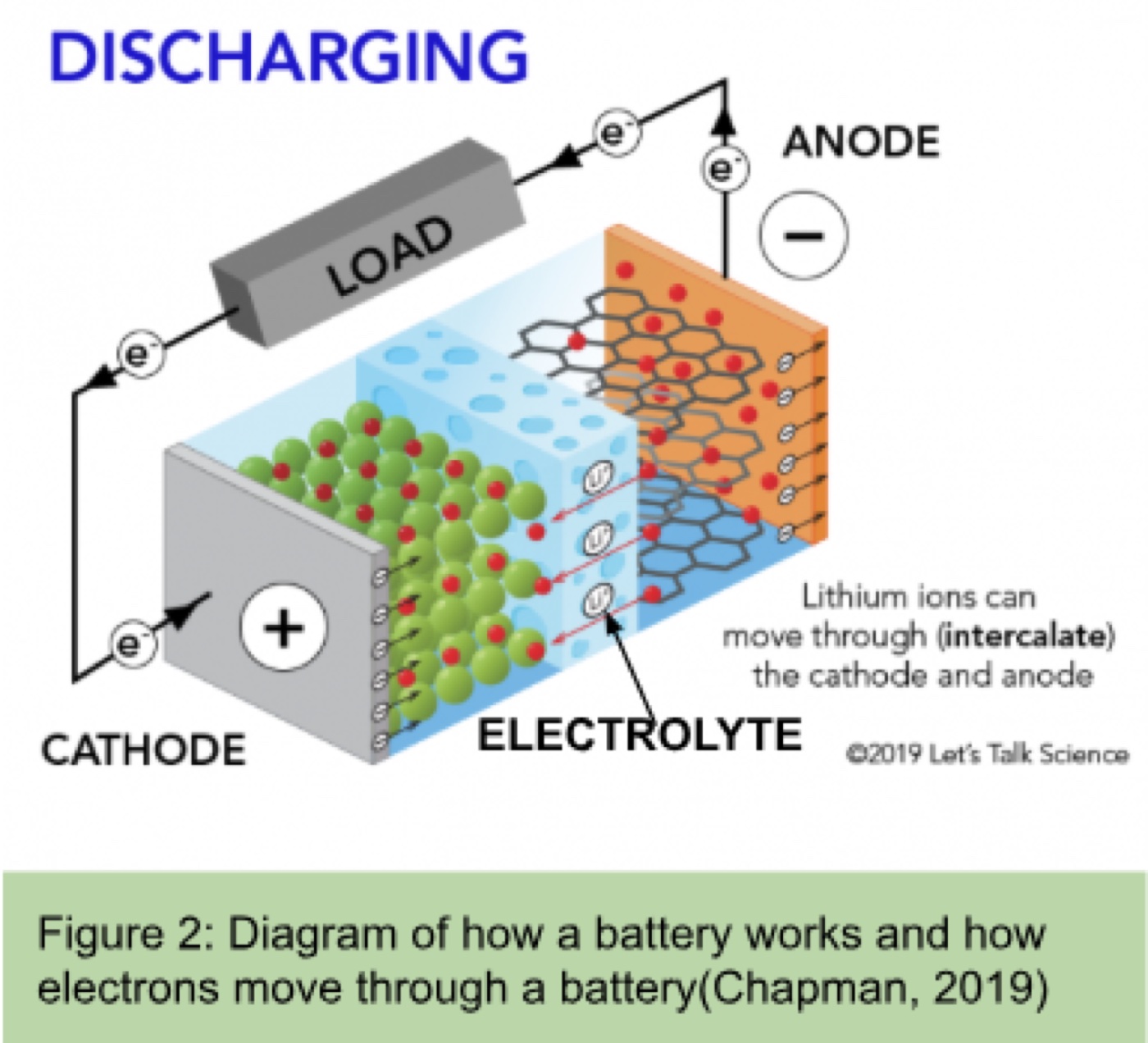
Before we dive into how the experiment worked, we need to learn more about how batteries work. On the left is a diagram showing the inner workings of a cell phone battery. As seen in the diagram, electrons move from one end of the wire to the other. Once they cross a load(component that pulls electron current away from the battery) such as a light, the negatively charged electrons power the load and simultaneously turn into a positively charged electron. The positively charged electron then moves through the positive electrode (cathode) and travels through the electrolyte
Figure 1: Diagram of how a battery works and how electrons move through a battery (Chapman, 2019)
Why Do We Need New Batteries?
As discussed above, liquid electrolyte batteries are used in most electronics today. These batteries are good because they have a long lifespan and are compact. However, they also have many problems such as overheating, leakage, and limited lithium supply. In addition, Lithium-ion batteries(the most common type of liquid electrolyte batteries) contain cobalt, which is mostly mined through child labor. Children working in the mines are paid around six cents (USD) daily, which brings up glaring ethical concerns (Purewal, 2022).
Of course, there are solid-state alternatives to Lithium-ion batteries that do not use cobalt. These batteries, however, have limitations as well. For example, Nickel-cadmium is a solid electrolyte battery that does not use cobalt. This type of battery is hard to damage and has a high energy density, allowing it to hold and release a lot of energy in a short amount of time. On the downside, nickel-cadmium batteries harm the environment when thrown away, and their long charge time limits their use. Overall, the limitations of the most commonly used batteries are why researchers from Microsoft and the Pacific Northwest National Laboratory wanted to find a new material for solid-state batteries.
The Experiment
The researchers utilized Microsoft’s Azure Quantum Elements platform, which uses a collection of AI tools and HPC(high-performance computing) to conduct a screening of potential battery materials(Lardinois, 2024). The diagram on the right shows the steps researchers took to get down to their final electrolyte. The researchers started by entering a dataset with over 32 million materials into the platform. The materials were then filtered through various AI algorithms that processed the materials according to predefined criteria, such as stability, conductivity, and costeffectiveness. The AI algorithms first checked to see how well the materials moved ions; if the material moved the ions efficiently, it would move on to the next stage. 150 materials made it past the first stage, and with the help of AI and the scientists, the top 18 materials were picked based on how easily their ingredients could be obtained. These 18 promising materials were then subjected to additional screening processes, directed by the scientists until the best material was identified. But what was this material?
Results
With help from AI, researchers were able to identify a new solid-state electrolyte material that is a combination of sodium, lithium, yttrium, and chloride ions(Conover, 2024). With these elements, scientists can create a solid-state electrolyte with 70% less lithium, no cobalt, and still has all the same benefits as a normal LithiumIon battery. According to Victoria Atkinson, an author from Chemistry World who has a PhD in chemistry, this new battery material could drastically reduce the price and environmental impact of these batteries in the future.(Atkinson, 2024) While further testing is required, the successful application of this AI in battery research shows AI’s potential to speed up scientific discoveries. Ultimately, this application of AI could transform fields like chemistry, material science, drug discovery, and environmental science. This is because AI can allow researchers to explore many more combinations, and it allows them to predict useful materials much faster than researchers can. In the future, we can see AI involved in every research project, which will allow for new materials, proteins, and even species to be discovered.
References
Atkinson, V. (2024, January 19). Scientists used AI to build a lowlithium battery from a new material that took just hours to discover. LiveScience. https://www.livescience.com/technology/artificial-intelligence/scientists-built-a-low-lithium-battery-from-a-new-material-that-took-just-hours-to-discover-thanks-to-ai
Conover, E. (2024, January 16). Artificial Intelligence helped scientists create a new type of battery . Science News. https://www.sciencenews.org/article/artificial-intelligence-new-battery
How does a lithium-ion battery work? - let’s talk science. (n.d.). https://letstalkscience.ca/educational-resources/stem-explained/how-does-a-lithium-ion-battery-work
Kawadkar, V. (2022, September 29). Ai might soon be able to predict your EV’s battery degradation. https://www.gizbot.com/. https://www.gizbot.com/electric-vehicles/ai-might-soon-be-able-to-predict-your-ev-battery-degradation-082829.html
Lardinois, F. (2024, January 9). Microsoft puts Azure Quantum Elements to work. TechCrunch. https://techcrunch.com/2024/01/09/microsoft-puts-azure-quantum-elements-to-work/
Millholland, C. D. (2023, June 12). Electrolyte materials in lithiumion batteries. Advancing Materials. https://www.thermofisher.com/blog/materials/electrolyte-materials-in-lithium-ion-batteries/
Pessarlay, W. (2024, March 10). Ai helps scientists create new battery type in under 80 hours. CoinGeek. https://coingeek.com/ai-helps-scientists-create-new-battery-type-in-under-80-hours/
Purewal, A. (2022, April 21). Sign the petition. Change.org. https://www.change.org/p/canada-s-trade-minister-cobalt-crisis-in-the-democratic-republic-of-congo
How to cite this article
Cooper, L. (2025). How AI is Helping Scientists Make Discoveries in Battery Science. Columbia Scientist, 4, 18–19. https://columbiascientist.org/articles/ai-battery-science
© 2025 Luke Cooper. This is an open-access article distributed under the terms of the Creative Commons Attribution 4.0 International licence, which permits use, distribution, and reproduction in any medium, provided the original author and source are credited.