Quantum Computing
Google’s Willow: Pioneering the Future of Quantum Chips
Google’s Willow chip crossed a threshold quantum computing has chased for decades: adding more qubits made it less error-prone, not more. What that means, and where it might lead.
- Published in
- Edition 4, Fall 2025
- Pages
- 11–13
- Licence
- CC BY 4.0
In an era marked by the unprecedented speed of technological advancements, quantum chips, like Google’s Willow, are reshaping the frontiers of computing. This article introduces the principle of quantum computing, highlights Willow’s achievements, and explores its potential application across multiple fields.
Willow is a quantum chip, also known as a central processing unit (CPU), that serves as the “brain” of a quantum computer—a highly advanced computing machine that leverages quantum mechanics to process information (Schneider, 2024).
Quantum Computers versus Classical Computers
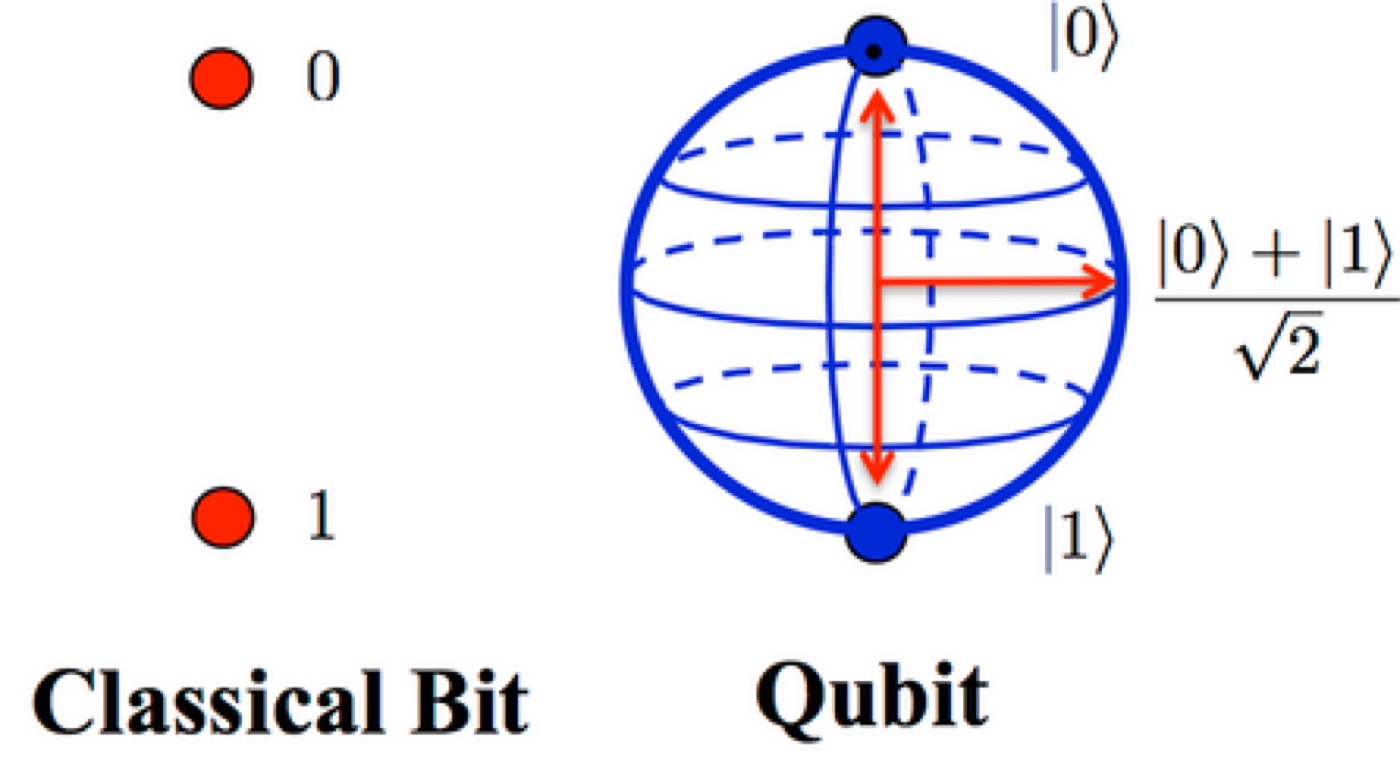
To begin, what sets quantum chips apart from traditional ones? Quantum computers leverage the unique properties of quantum bits—which, like classical bits, serve as the smallest units of information in a computer. While a bit represents a binary digit existing only in a mutually exclusive state of 0 or 1, a qubit can represent the two states simultaneously, a phenomenon called superposition (Usman, 2025).
Another transformative element of quantum computing is entanglement, where qubits become intrinsically linked. As posited by the EinsteinPodolsky-Rosen (EPR)
Figure 1: Visual representation of a classical bit and qubit (Usman, 2025).
Quantum Circuits
So, how do quantum computers solve problems? Computations are performed by manipulating qubits through a sequence of operations known as quantum gates, which can be demonstrated through quantum circuit models. These models consist of wires representing qubits, and gates that manipulate qubits into a new quantum state (Watrous, 2023).
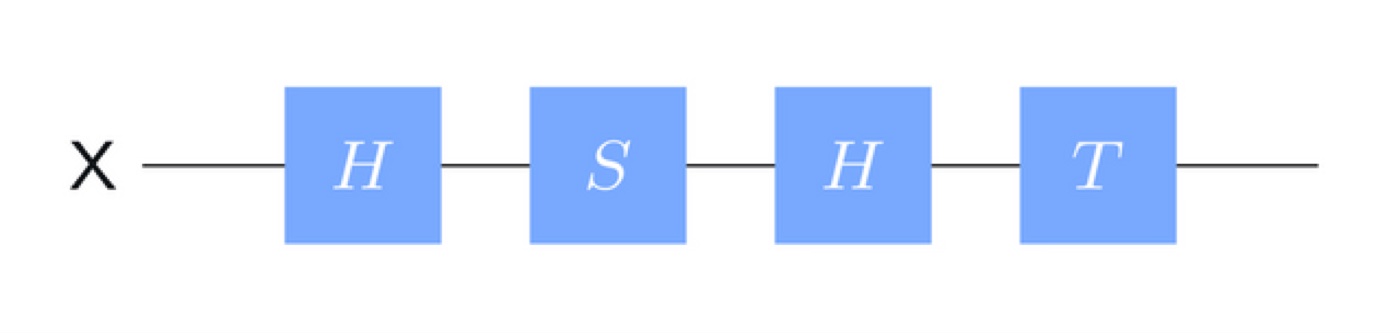
Figure 2: This quantum circuit shows the single qubit X undergoing a sequence of operations: Hadamard (H), S, Hadamard (H), and T, forming the operation THSH
(Watrous, 2023).
Quantum gates use constructive and destructive interference to either reinforce or cancel out certain states. When gates are applied to reinforce certain states, the probabilities of those states increase upon measurement. Conversely, when gates cancel out certain states, those probabilities become less likely. This principle allows quantum computers to amplify the probabilities of correct solutions while minimizing those of incorrect solutions, allowing faster detection of the solution (Watrous, 2023).
Quantum Error Correction
Despite the remarkable properties of quantum computing, its practical development has long been hindered by qubits’ sensitivity to environmental disturbances—e.g., temperature fluctuations, noise, electromagnetic interference, cosmic radiation—which cause decoherence, a process in which qubits lose their quantum information (Wootton, 2018). In this way, decoherence is a severe limiting factor, whereby increasing the number of qubits increases error rates and severely limits scalability (Ahmed, 2024).
Willow’s Achievement
Willow, Google’s latest quantum processor and the successor to Sycamore, has tackled the problem of decoherence using “below threshold” error correction—a technique where adding more qubits actually suppresses errors rather than amplifying them (Moss, 2024).
Willow was evaluated using Random Circuit Sampling (RCS), a benchmarking technique developed by Google that evaluates a quantum chip’s ability to generate and verify highly complex quantum circuits. Using this method, Willow completed a computation in five minutes that would take the world’s fastest classical supercomputer, Frontier, 10 septillion years—a span that far exceeds the age of the universe (Neven, 2024).
This breakthrough was achieved via surface codes and logical qubits, concepts pioneered by Peter Shor in 1995.
Surface codes organize qubits in a two-dimensional grid, allowing the system to detect and fix errors without inefficiently measuring individual qubits. Logical qubits distribute data redundantly across multiple physical qubits, so if some of them experience errors, the original data can be accurately retrieved. This synergy enables scalable, fault-tolerant quantum computing (Newman & Satzinger, 2024).
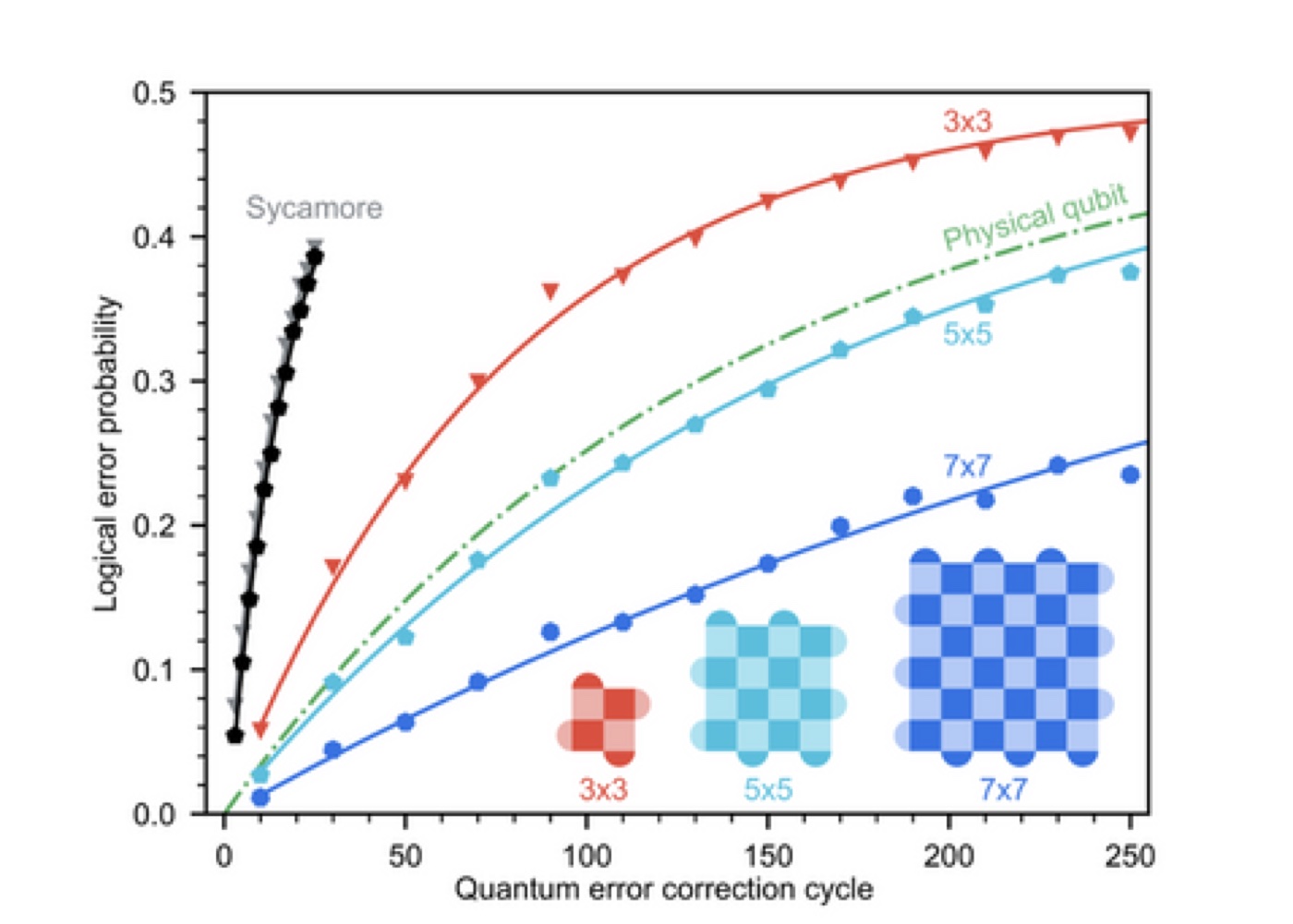
Figure 4: Increasing the lattice size from 3x3 to 5x5 to 7x7 reduces the encoded error rate by a factor of 2.14 with each expansion (Newman & Satzinger, 2024).
Applications Across Industries
Willow’s success marks the dawn of a new technological era. For example, it can enhance molecular modeling by simulating atomic and subatomic interactions with exceptional accuracy— something traditional computers struggle with due to the complexity of electron behavior. This capability could accelerate breakthroughs in drug discovery, protein folding, and material design (Abelson, 2024). Beyond the sciences, quantum algorithms can help detect fraud patterns and model complex market dynamics (Koffman and Maclellan, 2024). Willow transforms quantum computing from a theoretical concept into a practical technology that paves the way for innovation and complex problem-solving. However, despite this progress, further development is still needed before quantum technologies can overcome other current limitations and reach their full potential in realworld applications.
References
Abelson, D. B. (2024, December 13). Google’s Willow Chip: Transforming Medicine, Energy, and Technology. Motion Specific Release. Retrieved February 20, 2025, from https://www.motionspecificrelease.com/post/medicine-energy-more-google-s-willow-chip#:~:text=One%20of%20the%20biggest%20challenges,pract ical%20for%20real%2Dworld%20applications
Adhikari, R., Chen, X., Endres, M., & Preskill, J. (2021, October 11). What Is Entanglement and Why Is It Important? Caltech Science Exchange. Retrieved February 20, 2025, from https://scienceexchange.caltech.edu/topics/quantum-science-explained/entanglement#relativity-remains-intact
Ahmed, Z. (2024, December 11). Quantum doubts: Experts cast shadow on Google’s Willow chip “septillion years” claim. Techspot. Retrieved February 20, 2025, from https://www.techspot.com/news/105918-experts-cast-doubt-google-septillion-years-claim-new.html
Moss, S. (2024, December 10). Google debuts Willow quantum computing chip, claims new breakthroughs. Data Center Dynamics. Retrieved February 20, 2025, from https://www.datacenterdynamics.com/en/news/google-debuts-willow-quantum-computing-chip/
Neven, H. (2024, December 9). Meet Willow, our state-of-the-art quantum chip. Google. Retrieved February 16, 2025, from https://blog.google/technology/research/google-willow-quantum-chip/
Newman, M., & Satzinger, K. (2024, December 9). Making quantum error correction work. Google Research. Retrieved February 20, 2025, from https://research.google/blog/making-quantum-error-correction-work/
Schneider, J. (2024, August 5). What is quantum computing? (I. Smalley, Ed.). IBM. Retrieved February 27, 2025, from https://www.ibm.com/think/topics/quantum-computing
Usman, M. (2025, January 8). 2025 Will See Huge Advances in Quantum Computing. So What is a Quantum Chip And How Does it Work? Quantum Insider. Retrieved February 20, 2025, from https://thequantuminsider.com/2025/01/08/2025-will-see-huge-advances-in-quantum-computing-so-what-is-a-quantum-chip-and-how-does-it-work/#:~:text=A%20single%20bit%20can%20represent, (known%20as%20control%20signals)
Watrous, J. (2023, January 25). Basics of Quantum Information. IBM Quantum Learning. Retrieved March 1, 2025, from https://learning.quantum.ibm.com/course/basics-of-quantum-information/quantum-circuits
Wootton, J. (2018, August 11). What exactly is “Random Circuit Sampling”? Quantum Computing. Retrieved February 20, 2025, from https://quantumcomputing.stackexchange.com/questions/40 05/what-exactly-is-random-circuit-sampling
Koffman, T., & Maclellan, K. (2024, December 15). Quantum Leap: How Google’s Willow Chip Could Redefine the Future of Finance. Myth of Money. Retrieved May 31, 2025, from https://mythofmoney.substack.com/p/quantum-leap-how-googles-willow-chip
How to cite this article
Rosenthal, E. (2025). Google’s Willow: Pioneering the Future of Quantum Chips. Columbia Scientist, 4, 11–13. https://columbiascientist.org/articles/googles-willow
© 2025 Emily Rosenthal. This is an open-access article distributed under the terms of the Creative Commons Attribution 4.0 International licence, which permits use, distribution, and reproduction in any medium, provided the original author and source are credited.