Chemistry
The Ultimate Quantum Detective: Nuclear Magnetic Resonance
Flip a nucleus with a radio pulse and it gives away its chemical surroundings. A primer on how NMR reads molecules atom by atom, from methyl acetate's two peaks to MRI scanners and pesticide checks.
- Published in
- Edition 2, Spring 2023
- Pages
- 33–36
- Licence
- CC BY 4.0
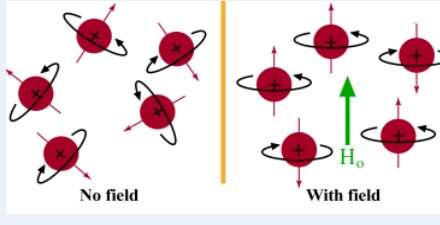
Nuclear magnetic resonance (NMR) is an advanced characterization technique widely used in chemistry, physics, and biology. It allows scientists to determine the molecular structure of a sample at the atomic level by analyzing the behavior of its atomic nuclei under the influence of a magnetic field [1].
How it works:
The basic principle behind NMR is that atomic nuclei with an odd number of protons or neutrons possess a property known as spin. Spin is a quantum mechanical property that describes the intrinsic angular momentum of a particle. In the presence of a magnetic field, atomic nuclei will align themselves either with the direction of the field (α-spin) or against the direction of the field (β-spin). β-spin is the higher energy state since it takes more energy to align against the magnetic field [2].
Shielded atoms describe nuclei that are surrounded by a high electron density such that the inner electrons “shield” the outer valence electrons from feeling the full attraction of the nucleus. Shielded atoms have a smaller energy difference between the alpha and beta spin compared to deshielded atoms.
- A sample is subjected to a strong, constant magnetic field.
- Some nuclei will align themselves with the direction of the field, while others will align themselves against the direction of the field, resulting in two possible spin states at two different energy states.
- A radio frequency (RF) pulse is applied to the sample. Absorbing this pulse allows nuclei in the lower energy state to transition to the higher state by flipping their direction [3].
Nuclei interact with the RP pulse differently depending on the strength of the magnetic field and the chemical environment of the nucleus. This chemical environment is determined by a nucleus’ surrounding atoms and relative position in a molecule, as well as whether the nucleus is shielded or deshielded. The intensity and shape of the absorption signal reflect the number and arrangement of the atomic nuclei in the sample [2]. The nucleus’ level of absorption of the RF pulse contains information about the chemical and physical properties of the sample.
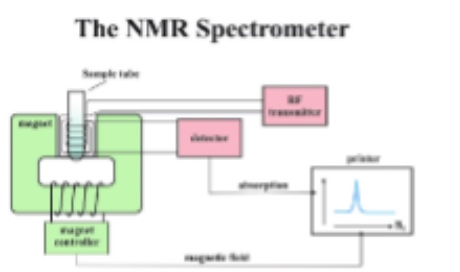
Figure 1: Schematic of a typical nuclear magnetic resonance spectrometer [4]
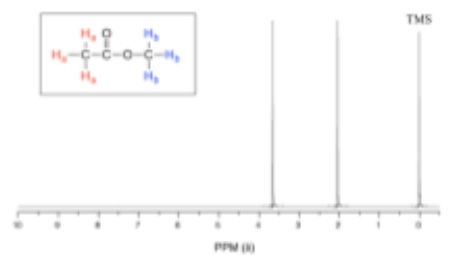
Figure 2: The ¹H NMR spectrum of methyl acetate. [5]
On the left is the ¹H NMR, or proton NMR, spectrum produced by methyl acetate. This means that it is the proton in the nucleus of the ¹H isotope that is observed. It’s also important to note that the peak at the far right labeled TMS is for the standard reference compound, not for the compound of interest.
Therefore, only 2 of the peaks in this spectrum are associated with methyl acetate. On the right is the actual molecular structure of methyl acetate. The reason that there are only 2 peaks for a compound containing a total of 6 hydrogens is because the hydrogens are grouped by their chemical environment- the 3 hydrogens in the methyl group bonded with C=O are one group and the 3 hydrogens in the methyl group bonded with O are the other [5].
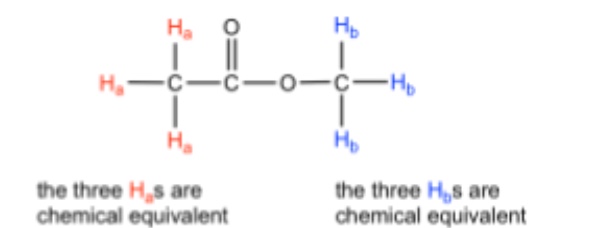
Figure 3: The molecular structure of methyl acetate. [5]
That’s pretty cool! But how is this useful to us?
NMR is a powerful tool that’s used in a wide range of applications, from determining the structure of small molecules to studying the dynamics of large biological systems.
Food safety testing: NMR spectroscopy is used to test food products for quality and safety. For example, NMR can be used to analyze the sugar content of soft drinks, detect the presence of pesticides in fruits and vegetables, and verify the authenticity of food products such as olive oil and honey [6].
Magnetic resonance imaging: NMR is a fundamental part of magnetic resonance imaging (MRI), a noninvasive medical imaging technology. MRI machines use strong magnetic fields and radiofrequency pulses to excite the nuclei of hydrogen atoms in water molecules, generating a detectable NMR signal. The intensity and frequency of the NMR signal are then processed to generate high-resolution images of the body’s internal structures [7].
Environmental monitoring: NMR spectroscopy is used in environmental monitoring to analyze soil and water samples for pollutants and other contaminants, such as the EPA-regulated per/poly-fluoroalkyl substances (PFAS). For example, NMR can be used to detect the presence of heavy metals in soil samples or to analyze the composition of oil spills in water [8].
Conclusion and Looking Ahead
NMR is a powerful technique used in a variety of scientific fields. By analyzing the behavior of atomic nuclei under the influence of a magnetic field, scientists can determine the molecular structure of a sample at the atomic level. The versatility of NMR makes it a useful tool for solving some of the world’s most pressing problems today in areas such as food safety testing, medical imaging, and environmental monitoring.
Looking to the future, NMR spectroscopy is bound to continue to play an important role in scientific research and innovation. Advances in technology- such as a greater availability of benchtop, portable instruments and the miniaturization of RF spectrometer electronics- have increased the accessibility of NMR spectroscopy to a broader community of scientific researchers [9]. Indeed, in recent years NMR has been used heavily in the field of metabolomics- the study of small molecules, known as metabolites, in a biological system [10].
With its ability to reveal the hidden world of atoms and molecules, NMR is sure to be a valuable tool for years to come.
References
[1] Hunt, Ian. “Ch 13 - NMR basics.” Chemistry, https://www.chem.ucalgary.ca/courses/351/Carey5th/Ch13/ch13-nmr-1.html.
[2] Maciejewski, Mark. “Basics of NMR Spectroscopy.” UConn Health, 29 November 2016, https://health.uconn.edu/bioinformatics/wp-content/uploads/sites/162/2017/11/NMRBasics_2016.pdf.
[3] “Magnetic Resonance Imaging (MRI).” National Institute of Biomedical Imaging and Bioengineering |, https://www.nibib.nih.gov/science-education/science-topics/magnetic-resonance-imaging-mri.
[4] Parlak, Yeliz, and Nuray Güzeler. “Nuclear Magnetic Resonance Spectroscopy Applications In Foods.” Current Research in Nutrition and Food Science, 8 October 2016, https://www.foodandnutritionjournal.org/vol04nospl-issue-conf-october-2016/nuclear-magnetic-resonance-spectroscopy-applications-in-foods/.
[5] “6.6 ¹H NMR Spectra and Interpretation (Part I) – Organic Chemistry I.” Kwantlen Polytechnic University, https://kpu.pressbooks.pub/organicchemistry/chapter/6-6-1h-nmr-spectra-and-interpretation/.
[6] Simpson, Andre, et al. “Environmental Nuclear Magnetic Resonance Spectroscopy: An Overview and a Primer.” ACS Publications, American Chemical Society, 13 November 2017, https://pubs.acs.org/doi/10.1021/acs.analchem.7b03241.
[7] Singh, Mukesh K., and Annika Singh. “Chapter 14 - Nuclear Magnetic Resonance Spectroscopy.” ScienceDirect, https://www.sciencedirect.com/science/article/pii/B9780128239865000117.
[8] Zia, Komal, et al. “Nuclear Magnetic Resonance Spectroscopy for Medical and Dental Applications: A Comprehensive Review.” 3 April 2020, https://www.thieme-connect.de/products/ejournals/abstract/10.1055/s-0039-1688654.
[9] Armstrong-Smith, Lestyn. “A Briefcase Full of NMR.” The Analytical Scientist, 23 March 2015, https://theanalyticalscientist.com/techniques-tools/a-briefcase-full-of-nmr.
[10] Wishart DS, Cheng LL, Copié V, Edison AS, Eghbalnia HR, Hoch JC, Gouveia GJ, Pathmasiri W, Powers R, Schock TB, Sumner LW, Uchimiya M. “NMR and Metabolomics—A Roadmap for the Future.” NCBI, National Library of Medicine, 23 July 2022, https://www.ncbi.nlm.nih.gov/pmc/articles/PMC9394421/.
How to cite this article
Malladi, S. (2023). The Ultimate Quantum Detective: Nuclear Magnetic Resonance. Columbia Scientist, 2, 33–36. https://columbiascientist.org/articles/ultimate-quantum-detective-nmr
© 2023 Sarvagna Malladi. This is an open-access article distributed under the terms of the Creative Commons Attribution 4.0 International licence, which permits use, distribution, and reproduction in any medium, provided the original author and source are credited.