Computational Design
Algorithmic Architecture and Computational Fluid Dynamics: Innovating Structural Design in the Spinning Desert Oasis Project
A desert research stint inspires a rotating oasis of Rubik's Cube clinics, projector-gear labs and nest-like dorms, shaped by fluid dynamics simulations to turn against wind and sand.
- Published in
- Edition 3, Winter 2024
- Pages
- 17–18
- Licence
- CC BY 4.0
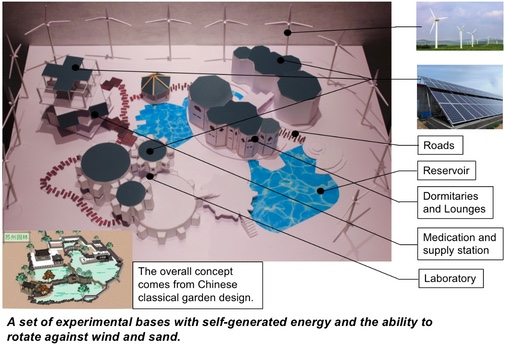
Under the guidance of Professor Gao, I worked as a research assistant in the National Natural Science Foundation of China program “Biological Induced Calcite Precipitation Technique aimed at combating desertification” from 2021 to 2022. This experience in geotechnical engineering, particularly using soybean urease-induced calcium carbonate deposition for windbreak and sand fixation, provided a foundational understanding of manipulating natural processes to enhance environmental stability. During our fieldwork in the desert, we faced such an environment’s typical and harsh conditions. To effectively address these challenges, I devised a multifunctional complex known as the “ Spinning Desert Oasis,” utilizing advanced computational modeling and simulation techniques to maximize adaptability and minimize environmental impact.
Figure 1: The Model of the “Spinning Desert Oasis” Design Project)
The Medical and Supply Station, a pivotal component of the Oasis, utilizes a design inspired by the Rubik’s Cube. This modular structure benefits from advanced computer-aided design (CAD) software, facilitating independent rotation of each segment. Michela Turrin, an expert in performance-oriented architecture and computational fluid dynamics (CFD), along with her colleagues, discusses in their critical review published in Renewable and Sustainable Energy Reviews that CFD “can significantly enhance the aerodynamic performance of buildings by simulating wind loading and sand erosion” (Turrin et al., 793). This capability is crucial in my design, as it helps mitigate damage from the severe desert winds commonly encountered in such environments.
The Laboratory unit, influenced by the interlocking gears of traditional movie projectors, consists of interconnected yet independent modules. This configuration employs algorithmic modeling to provide rotational flexibility, allowing adjustments in orientation based on real-time environmental data gathered through embedded sensors and integrated IoT systems. Turrin and her team further elaborate on the importance of CFD integration in the early design stages to enhance the adaptability of structures to their environmental contexts (Turrin et al., 794).
The Dormitories and Lounges, drawing inspiration from the nest-like structures of desert-dwelling organisms and the Australian concrete pipe hotel, are modeled using advanced simulation software to assess thermal dynamics. Elena Lurie-Luke, whose work on biomimicry and innovation in technology is well-documented in Biotechnology Advances, highlights that “biomimicry can lead to significant advancements in energy efficiency by replicating natural thermal regulation mechanisms in buildings” (Lurie-Luke, 1499). This approach has shaped the environmental integration of my design, optimizing comfort while maintaining energy efficiency.
Lastly, M. Nejat Bahadori, renowned for his studies on traditional passive cooling systems in Iranian architecture as detailed in Scientific American, underscores the value of historical methods in modern design: “Historical approaches to desert architecture, using passive cooling, can inform contemporary sustainable building practices” (Bahadori 146). Inspired by Bahadori’s insights, the Oasis incorporates passive cooling strategies such as shaded walkways and thermally insulated communal spaces that leverage natural ventilation to maintain comfort and reduce energy use, blending ancient wisdom with modern technological applications.
In conclusion, this design research showcases the integration of the Biological Induced Calcite Precipitation Technique with advanced architectural and computational methods to establish a sustainable habitat in deserts. The “Oasis” project leverages interdisciplinary approaches combining geotechnical engineering, biomimicry, and computational fluid dynamics to enhance adaptability and sustainability in extreme environments. This endeavor demonstrates the potential of merging traditional architectural insights with modern technology to address environmental challenges effectively, highlighting the crucial role of innovative scientific research in sustainable development.
References
Marteau, T. M., & Croyle, R. T. (1998, February 28). The new genetics. psy- chological responses to genetic testing. BMJ (Clinical research ed.). Retrieved November 15, 2022, from https://www.ncbi.nlm.nih.gov/pmc/articles/ PMC1112686/
Marteau, T. M., & Croyle, R. T. (1998, February 28). The new genetics. psy- chological responses to genetic testing. BMJ (Clinical research ed.). Retrieved November 15, 2022, from https://www.ncbi.nlm.nih.gov/pmc/articles/ PMC1112686/
Marteau, T. M., & Croyle, R. T. (1998, February 28). The new genetics. psy- chological responses to genetic testing. BMJ (Clinical research ed.). Retrieved November 15, 2022, from https://www.ncbi.nlm.nih.gov/pmc/articles/ PMC1112686/
How to cite this article
Su, C. (. (2024). Algorithmic Architecture and Computational Fluid Dynamics: Innovating Structural Design in the Spinning Desert Oasis Project. Columbia Scientist, 3, 17–18. https://columbiascientist.org/articles/spinning-desert-oasis
© 2024 Crystal (Yirou) Su. This is an open-access article distributed under the terms of the Creative Commons Attribution 4.0 International licence, which permits use, distribution, and reproduction in any medium, provided the original author and source are credited.
More from Edition 3
Full table of contents →Regenerative Medicine
Bloody Breakthrough: Menstrual Blood-Derived Stem Cell TherapyGene Therapy
Whispers of Tomorrow: Gene Therapy’s Quest to Silence NeurodegenerationHealthcare and Media
Ozempic and the “Miracle Drug” Craze