Biotechnology
Organ-on-a-Chip: No, it’s Not a Snack
Nearly 90 percent of drug candidates fail in human trials. Chips the size of a USB drive, lined with living human cells, could catch them sooner.
- Published in
- Edition 5, Fall 2026
- Pages
- 17–19
- Licence
- CC BY 4.0
If you were presented with a drug and tasked with determining whether it could be therapeutic or safe for humans, what would you do? Would you give it to your next-door neighbor and record whether they go limp? Of course not! Well, hopefully not.
Naturally, safety should be your first concern, and the thought of jumping straight into human experimentation should seem reckless. However, prior to the mid-twentieth century, there were few regulations to ensure drug safety, often leading to devastating consequences. In the late 1950s, Thalidomide was widely prescribed to pregnant women as a safe way to treat nausea, but due to lax testing, over 10,000 children were born with phocomelia, a severe limb malformation disorder (Kim and Scialli, 2011). Cases like this highlight the dangers of haphazardly introducing foreign substances into the human body and justify the reality of current pharmaceutical testing. The rigorous modern drug development process begins with an array of chemical analyses, followed by progressively demanding stages of animal testing, and ultimately culminates in multi-phase human clinical trials. The clinical trials are separated into four phases spanning from initially testing basic safety and dosage to eventually evaluating efficacy and side effects in increasingly larger and diverse populations, with each phase taking years to design, conduct, and analyze (U.S. Food and Drug Administration, 2018). Even at this final stage, nearly 90% of drug candidates still fail (Sun et al., 2022). As a result, the average production cycle for a single drug takes more than a decade and costs upwards of a billion dollars (Patheon, 2023). With this in mind, it’s no wonder that researchers are searching for methods to expedite the process by incorporating human biology into earlier stages of testing.
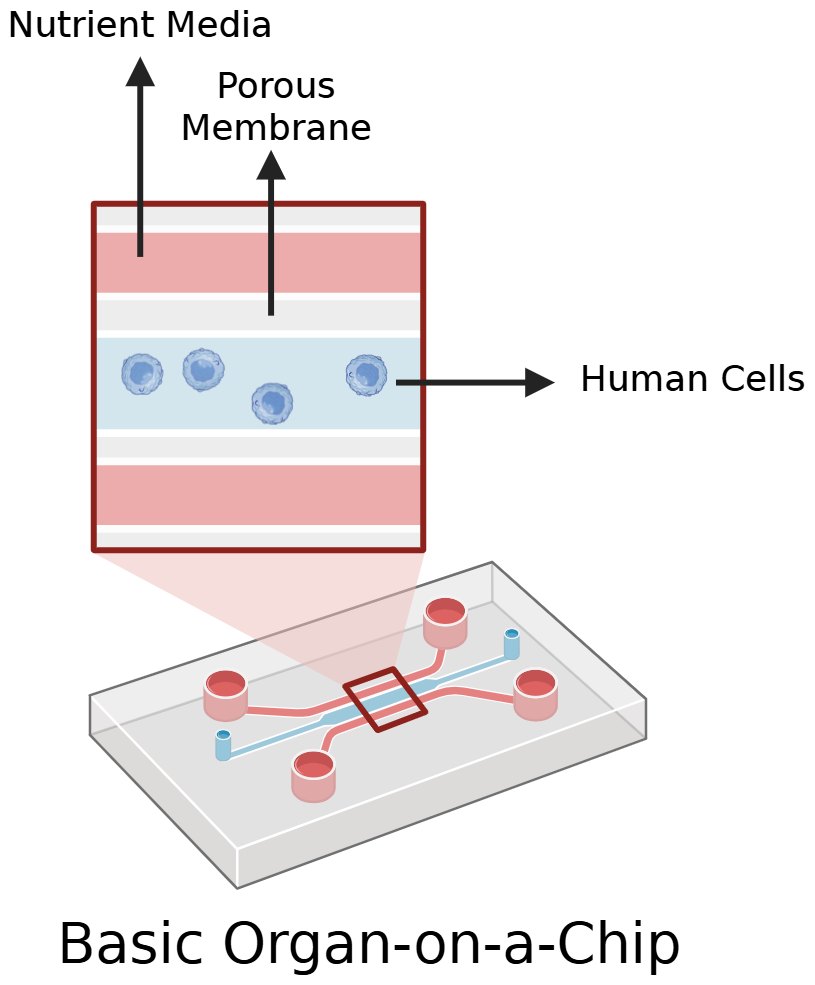
Fig. 1. General structure of OoC showing how nutrient fluid and human cells interact
Enter Organ-on-a-Chip (OoC) Technology—a remarkable innovation that merges biology and engineering to simulate the functions, structure, and biochemical environment of human organs on a miniature scale and completely separate from the body. First introduced in the early 2010s with the pioneering work by the Wyss Institute on a lung-on-a-chip, this technology is rapidly evolving as a promising tool for drug modeling (Huh et al., 2010). Often no bigger than a USB drive, OoCs contain a network of precise channels that work with fluids as small as one trillionth of a liter and a chamber lined with human cells sourced from either tissue donations or differentiated stem cells, as seen in Figure 1 (Leung et al., 2022). Like tiny blood vessels, these channels provide a continuous flow of nutrient-rich fluid over the cells so that they can function. At the same time, they also give scientists unique access and customizability over what is introduced to the cells, allowing them to systematically vary nutrients or drugs and directly observe cellular response in real time, enabling controlled analysis of drug effects without risking a human life.
As their name suggests, each chip is designed to emulate a specific organ. This is achieved not only by incorporating organ-specific cells and carefully controlled fluid environments that replicate nutrient delivery, but also mechanically. Modern chips have engineered features to replicate the defining characteristics of their organ, providing more realistic modeling. For example, a lung-on-a-chip provides a cyclic stretching motion on the cell tissue to mimic what occurs during breathing; a heart-on-a-chip uses a rhythmic pulse and electrical stimulation on the cells similar to how a heart beats; a gut-on-a-chip uses a controlled flow of nutrients to model the gut’s interaction with food (Wyss 2010 & Singh et al., 2022).
Together, these features mean that OoC technology occupies a sort of limbo territory within drug modeling—they are more complex than traditional 2D tissue engineering typically done on petri dishes, which lack layered cells, realistic cell-on-cell interactions, and fluid flow, but are not nearly as biologically complete as living organisms or even organs themselves (Leung et al., 2022). While this position comes with limitations in replicating realistic organ responses, what OoC technology sacrifices in physiological relevance, it makes up for in improved investigation. Because OoC systems isolate specific tissues and function under a controlled setting, researchers do not have to account for the myriad of interacting biological systems in human patients that can introduce noise and variability. Factors such as metabolism, immune responses, and the interaction between organs can all obscure the effects of what researchers want to study. Instead, scientists are able to precisely vary variables such as oxygen levels or pH to test them one at a time, leading to more reproducible and clear experiments that make it easier to identify how a drug, toxin, or disease affects a specific biological process. Beyond merely controlling what is introduced into the cells, researchers also have the ability to swap out the cells themselves (Leung et al., 2022). As previously mentioned, the cells can come directly from a person’s organ, meaning that researchers can better test sub-populations or unique patient profiles that might otherwise go unnoticed until the final phases of clinical trials. For example, cells derived from patients suffering from cystic fibrosis (an autosomal recessive disease) were used on OoC models to better study the effects of different therapies and pave the way towards more personalized medicine (Ogden et al., 2021).
For now, this marks just the beginning of OoC technology. The drug research field has yet to standardize its chip design, and some engineering challenges—such as material choices causing uncontrolled evaporation and leakage—are still being addressed and optimized. The Food and Drug Administration (FDA) has recently begun to show growing interest and engagement through its acceptance of its first OoC technology (a liver-on-a-chip) into the Innovative Science and Technology Approaches for New Drugs (ISTAND) Pilot Program (U.S. Food and Drug Administration, 2024). Here, the chip will be assessed for its efficacy and performance as a predictive tool for drug-induced liver toxicity, and if the results are positive, it could mark an important step toward formal integration and widespread approval for the technology. As expected, OoCs have already begun to evolve, with current designs linking different types of organ cells to create a “Body-on-a-Chip” (Singh et al., 2022). These advances not only hold promise in improving how we study drugs by introducing a safer and accessible alternative for observing human biological reactions, but also build on technology’s core strengths in experimental control, reproducibility, and patient-specific customization. As researchers refine their designs and aim towards more ambitious modeling, OoC technology edges closer to a more efficient future where testing drugs might not require a patient at all—just a chip that mimics one.
References
- Center. “FDA Accepts First ISTAND Proposal.” U.S. Food and Drug Administration, 2026, www.fda.gov/drugs/drug-alerts-and-statements/fdas-istand-pilot-program-accepts-submission-first-organ-chip-technology-designed-predict-human-drug? Accessed 27 Apr. 2026.
- FDA. “Step 3: Clinical Research.” U.S. Food and Drug Administration, 4 Jan. 2018, www.fda.gov/patients/drug-development-process/step-3-clinical-research.
- Huh, Dongeun, et al. “Reconstituting Organ-Level Lung Functions on a Chip.” Science (New York, N.Y.), vol. 328, no. 5986, 2010, pp. 1662–68, https://doi.org/10.1126/science.1188302.
- Kim, James H., and Anthony R. Scialli. “Thalidomide: The Tragedy of Birth Defects and the Effective Treatment of Disease.” Toxicological Sciences, vol. 122, no. 1, Apr. 2011, pp. 1–6.
- Leung, Chak Ming, et al. “A Guide to the Organ-On-a-Chip.” Nature Reviews Methods Primers, vol. 2, no. 1, May 2022, pp. 1–29, https://doi.org/10.1038/s43586-022-00118-6.
- Ogden, Herbert Luke, et al. “Cystic Fibrosis Human Organs-On-a-Chip.” Micromachines, vol. 12, no. 7, July 2021, p. 747, https://doi.org/10.3390/mi12070747. Accessed 5 Sept. 2021.
- Patheon. “The 5 Drug Development Phases.” Www.patheon.com, 23 Oct. 2023, www.patheon.com/us/en/insights-resources/blog/drug-development-phases.html.
- Singh, Deepanmol, et al. “Journey of Organ on a Chip Technology and Its Role in Future Healthcare Scenario.” Applied Surface Science Advances, vol. 9, no. 100246, June 2022, p. 100246, https://doi.org/10.1016/j.apsadv.2022.100246.
- Sun, Duxin, et al. “Why 90% of Clinical Drug Development Fails and How to Improve It?” Acta Pharmaceutica Sinica B, vol. 12, no. 7, Feb. 2022, pmc.ncbi.nlm.nih.gov/articles/PMC9293739/.
- Wyss. “Living, Breathing Human Lung-On-a-Chip: A Potential Drug-Testing Alternative.” Wyss Institute, 24 June 2010, wyss.harvard.edu/news/living-breathing-human-lung-on-a-chip-a-potential-drug-testing-alternative/? Accessed 27 Apr. 2026.
How to cite this article
Navarro, B. C. (2026). Organ-on-a-Chip: No, it’s Not a Snack. Columbia Scientist, 5, 17–19. https://columbiascientist.org/articles/organ-on-a-chip
© 2026 Bernardo Carlos Navarro. This is an open-access article distributed under the terms of the Creative Commons Attribution 4.0 International licence, which permits use, distribution, and reproduction in any medium, provided the original author and source are credited.