Medicine
Neuronanomedicine and the Future of Central Nervous System-Related Disorders
Most drugs for brain disease never get past the blood-brain barrier. Nanoparticles built to cross it could change that.
- Published in
- Edition 5, Fall 2026
- Pages
- 32–34
- Licence
- CC BY 4.0
Disorders of the brain and central nervous system (CNS) are quietly becoming one of the greatest health challenges of the twenty-first century. Alzheimer’s disease, Parkinson’s disease, epilepsy, stroke, multiple sclerosis, depression, brain tumors, chronic pain, and many other conditions now affect hundreds of millions of people worldwide. These illnesses not only affect health but also significantly diminish quality of life. They steal memory, movement, mood, independence, and often dignity. And yet, despite enormous scientific progress, meaningful breakthroughs in treating many brain disorders have been unfortunately slow. Consequently, healthcare systems strain under growing demand. The brain is protected by a powerful biological barrier that carefully controls what enters its delicate tissue. This barrier is called the blood-brain barrier (BBB) and is essential for survival, as it shields us from toxins, infections, and harmful substances circulating in the blood. But it also blocks most therapeutic drugs (Tang et al., 2024). Many medicines that look promising in laboratory tests aren’t successful in real patients because they simply cannot pass this invisible barrier. Other drugs must be administered in high doses to ensure that a small amount reaches the brain, often flooding the rest of the body in the process. The result is a well-recognized pattern of limited benefits, repeated dose adjustments, and unwanted side effects. For decades, the main response to this problem has been to design stronger drugs. But no matter how advanced a medicine becomes, it remains limited if it cannot effectively reach its destination (Nance et al., 2022). This delivery problem has quietly become one of the biggest hidden barriers in modern neurology. We are searching for cures for neurological disorders, yet we are sending them on a journey they are not equipped to complete.
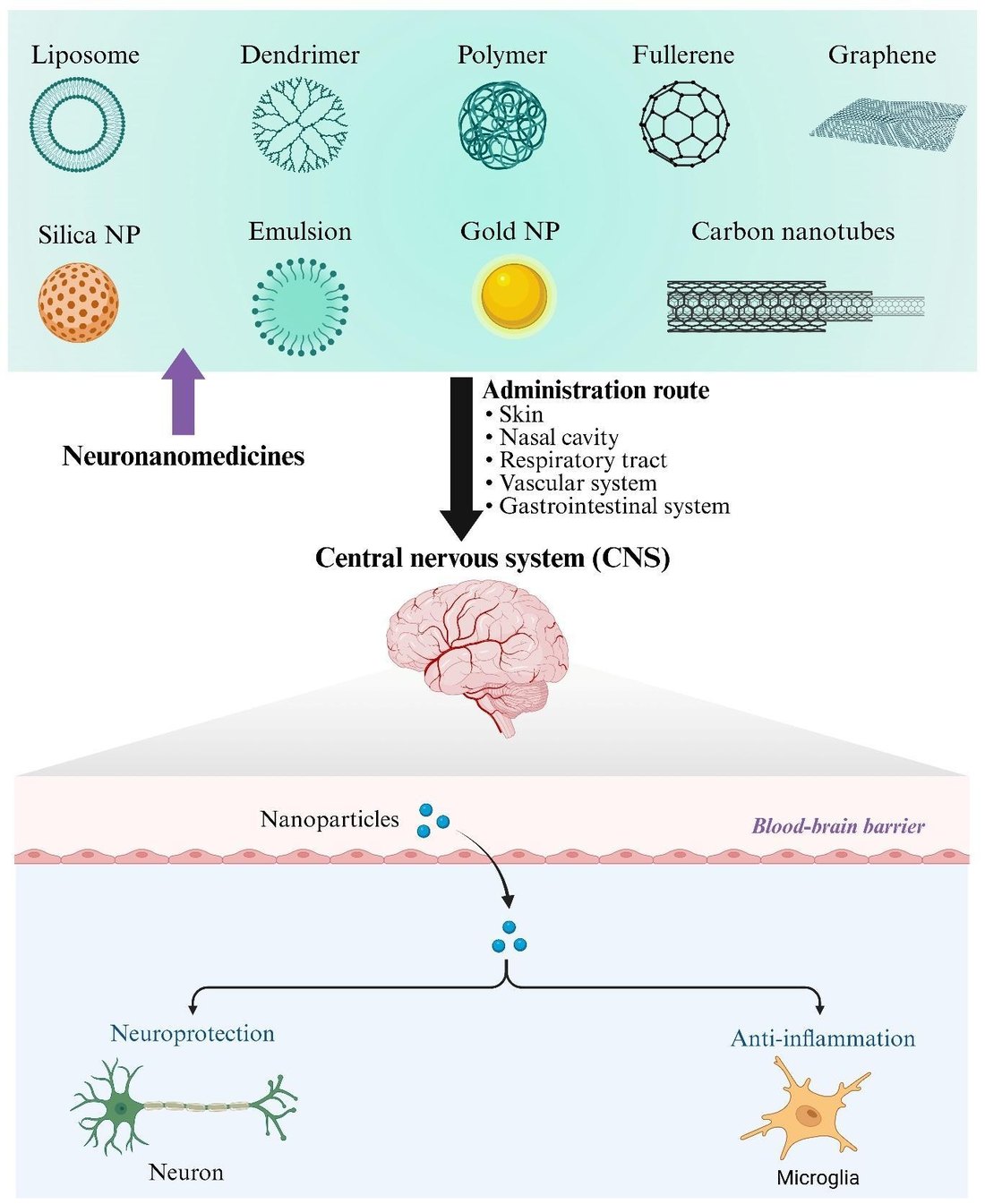
Neuronanomedicine offers a way out of this long-standing impasse. It uses extremely tiny carriers (sizes range smaller than 300 nm) to transport medicines through the bloodstream and guide them more effectively into the brain. These microscopic carriers help drugs overcome biological barriers such as the BBB, improve their circulation time, and increase the likelihood that they will reach the tissues they are meant to treat. Instead of administering medicines and hoping for the best, neuronanomedicine introduces direction, precision, and control (Teleanu et al., 2019). These nanoscale carriers can be engineered to interact with specific receptors on the BBB, enabling them to cross into brain tissue through mechanisms such as receptor-mediated transport or transcytosis. Once inside, they release therapeutic agents in a controlled manner at the target site (Figure 1).
Consider epilepsy, where unpredictable seizures can disrupt education, employment, and social life. More consistent delivery of medication to the brain could mean fewer seizures and greater independence. In Parkinson’s disease, where motor symptoms can vary significantly between medication doses, improved delivery could lead to steadier control of symptoms (Li et al., 2024). In depression and anxiety disorders, where finding the right medication can take months or years, better targeting could improve the reliability of treatment response. In Alzheimer’s disease, where even small delays matter, more effective delivery could preserve memory and daily functioning for longer. This means patients have more time spent living rather than managing illness. It also means fewer hospital visits, less disruption to family life, and greater ability to plan for the future (Nagri et al., 2023). The benefits also extend beyond individual patients. Better delivery means lower doses and fewer side effects, which can reduce long-term damage to organs such as the liver, kidneys, and heart. This can result in fewer hospital visits and lower overall healthcare costs. Neuronanomedicine is not just a theoretical concept. Early examples already exist. It has shown improved safety and fewer side effects compared with older versions of the same medicines. These early successes are modest, but they carry an important message: the brain is not unreachable; it has simply been undeliverable with the tools we have traditionally used (Waqar et al., 2025).
Figure 1. Conceptual framework of neuronanomedicine for CNS therapy.
Despite this promise, progress in brain drug delivery has been slow. One reason lies in how research priorities are set. Public attention, funding, and media coverage often focus on discovering new miracle drugs. Delivery science rarely receives the same recognition, even though it can determine whether a promising medicine succeeds or fails. After all, a powerful drug that cannot reach the brain is like a life-saving package that never arrives at its address. There is also a cultural aspect to consider. For years, medicine has been guided by the principle that stronger drugs and higher doses will solve difficult diseases. This approach has saved lives, but it has also reached its limits, especially in brain disorders (Gao et al., 2024; Deng et al., 2025). More force does not always mean better results. Often, it simply means more side effects and more suffering.
Neuronanomedicine represents a different philosophy. It values precision over pressure, guidance over flooding, and long-term quality of life over short-term intensity. It recognizes that effective treatment must also be humane treatment. As populations age worldwide, the urgency of shifting toward more precise and effective drug delivery approaches, such as neuronanomedicine, is growing. The number of people living with CNS-related disorders is rising faster than almost any other category of illness. These disorders shape not only individual lives but entire communities. For neuronanomedicine to fulfill its promise, coordinated action is needed. Governments must invest more in delivery-focused research. Further, regulatory bodies like the Food and Drug Administration (FDA) must modernize evaluation pathways to better accommodate the complexity of advanced delivery systems, enabling more efficient translation of safe and effective neuronanomedicines into clinical practice without compromising safety (Boyton et al., 2024; Sagar et al., 2025). Healthcare providers must be prepared to adopt new treatment platforms and integrate them into routine care.
The future of CNS care will not be shaped by a single miracle cure. It will be shaped by smarter systems such as neuronanomedicines that guide medicine to the places it is needed most. It has the potential to turn decades of laboratory discoveries into real-world applications and healing, to reduce suffering, and to give people more control over their lives (Yang, 2025). Neuronanomedicine is beginning to change that, and in doing so, it may redefine what modern medicine can finally achieve.
References
- Boyton, I., Valenzuela, S. M., Collins-Praino, L. E., & Care, A. (2024). Neuronanomedicine for Alzheimer’s and Parkinson’s disease: Current progress and a guide to improve clinical translation. Brain, Behavior, and Immunity, 115, 631-651. https://doi.org/10.1016/j.bbi.2023.11.004.
- Deng, Y., Feng, Y., Ye, B., et al. (2025). Application of nanomaterials in central nervous system disorders. Psychopharmacology, 242(12), 2619-2632. https://doi.org/10.1007/s00213-025-06862-3.
- Gao, J., Xia, Z., Gunasekar, S., Jiang, C., Karp, J. M., & Joshi, N. (2024). Precision drug delivery to the central nervous system using engineered nanoparticles. Nature Reviews Materials, 9(8), 567-588. https://doi.org/10.1038/s41578-024-00695-w.
- Li, S., Zhang, W., Zhu, Y., et al. (2024). Nanomedicine revolutionizes epilepsy treatment: Overcoming therapeutic hurdles with nanoscale solutions. Expert Opinion on Drug Delivery, 21(5), 735-750. https://doi.org/10.1080/17425247.2024.2360528.
- Nagri, S., Rice, O., & Chen, Y. (2023). Nanomedicine strategies for central nervous system (CNS) diseases. Frontiers in Biomaterials Science, 2, 1215384. https://doi.org/10.3389/fbiom.2023.1215384.
- Nance, E., Pun, S. H., Saigal, R., & Sellers, D. L. (2022). Drug delivery to the central nervous system. Nature Reviews Materials, 7(4), 314-331. https://doi.org/10.1038/s41578-021-00394-w.
- Sagar, G., Wilson, B., Mukundan, G. K., Divekar, K., & Jenita, J. L. (2025). Nanomedicine for treating major brain diseases: Advances and future directions. Molecular Pharmaceutics, 22(8), 4413-4434. https://doi.org/10.1021/acs.molpharmaceut.5c00277.
- Tang, L., Zhang, R., Wang, Y., et al. (2024). Nanoparticle delivery for central nervous system diseases and its clinical application. Nano Research, 17(7), 6305-6322. https://doi.org/10.1007/s12274-024-6598-1.
- Teleanu, D. M., Chircov, C., Grumezescu, A. M., & Teleanu, R. I. (2019). Neuronanomedicine: An up-to-date overview. Pharmaceutics, 11(3), 101. https://doi.org/10.3390/pharmaceutics11030101.
- Waqar, M. A., Mubarak, N., Khan, A. M., et al. (2025). Innovation in nanomedicine: Nanocarriers for central nervous system disorders management. International Journal of Polymeric Materials and Polymeric Biomaterials, 74(12), 1110-1127. https://doi.org/10.1080/00914037.2024.2399271.
- Yang, H. M. (2025). Overcoming the blood–brain barrier: Advanced strategies in targeted drug delivery for neurodegenerative diseases. Pharmaceutics, 17(8), 1041. https://doi.org/10.3390/pharmaceutics17081041.
How to cite this article
Nadimpalli, A. (2026). Neuronanomedicine and the Future of Central Nervous System-Related Disorders. Columbia Scientist, 5, 32–34. https://columbiascientist.org/articles/neuronanomedicine
© 2026 Aryan Nadimpalli. This is an open-access article distributed under the terms of the Creative Commons Attribution 4.0 International licence, which permits use, distribution, and reproduction in any medium, provided the original author and source are credited.