Medical Technology
Potential of Microrobots to Effectively Remove Blood Clots and Deliver Targeted Drugs
Blood thinners leave clots intact and thrombectomies invite infection. Magnetically steered helical microrobots could push clots aside, puncture their fibrin, and carry drugs exactly where the body needs them.
- Published in
- Edition 3, Winter 2024
- Pages
- 38–40
- Licence
- CC BY 4.0
Nearly 900,000 suffering Americans and over 100,00 deaths annually are attributed to fatal blood clotting conditions, particularly Venous Thromboembolism (VTE). Within the VTE classification, the most common dangerous blood clots are Deep Vein Thrombosis (DVT), where the blood clot is located within a deep vein (beneath layers of tissue and muscle), usually in an arm or leg, and Pulmonary Embolism (PE), where a blood clot travels from a deep vein to a lung (Ashorobi et al., 2020). Blood clots, which consist of platelets, proteins, and cells are often created to manage bleeding from damaged arterial or venous blood vessels. Without the formation of periodic blood clots, which promote healing, the body would lose a significant amount of blood through hemorrhages. However, blood clots can become dangerous when they obstruct blood vessels, resulting in various fatal consequences, including a heart attack or stroke.
Most often, blood clots are treated with anticoagulants, or blood thinners, to prevent the accumulation of platelets and proteins, allowing the body to break down the clots over time. Although blood thinners are a potential treatment for blood clots, the side effects over time may override their potential benefits. For instance, some side effects of blood thinners include excessive bleeding and physical weakness during and after taking the prescription. My grandmother, who was placed on blood thinning medication to counteract the formation of blood clots, is at severe risk because of her tendency to fall during her sleep, which increases the likelihood of fatal blood loss. The risk of suffering a fatal physical injury while taking prescribed blood thinners is higher because blood thinners make it easier to lose blood quickly. Yet, despite blood thinners being prescribed in order to treat blood clots, they diminish the risk of blood clots blocking blood vessels, but they do not completely break down blood clots in the bloodstream.
For this purpose, a more direct approach to this situation would be more effective at preventing blood clots from negatively progressing. Surgical operations to remove blood clots from an artery or vein, called thrombectomies, have been performed before to completely remove the clump from blocking blood vessels. Surgeries are performed in more dire scenarios where a very large blood clot poses a threat to the life of the patient. Despite surgery being a more effective alternative for treating dangerous blood clots, it comes with limitations and disadvantages in and of itself. Any kind of surgical procedure, including thrombectomies, has the potential to cause infections, as the wound is open and is susceptible to contagions in its vulnerable state. Additionally, thrombectomies specifically can cause excessive bleeding that could potentially result in death and damage the blood vessel at the site of the blood clot.
One novel method of treating these deadly blood clots without non-targeted blood thinner medications or infection-prone thrombectomies is the use of nanorobots to effectively remove blood clots with minimally invasive surgery. Microrobots can be utilized in this capacity to carry out targeted tasks within the circulatory system, which would be much more effective than blood thinner medications which aren’t able to reach specific parts of the body, or surgery, whose disadvantages outweigh the advantages. The specific tool used to detect the microrobots is Hall-effect sensors, which are able to detect the proximity and speed of the robots through their position and change in voltage on a magnetic field. Microrobots have access to deep-seated areas of the body that are otherwise unreachable by physical surgical operations; therefore, Hall-effect sensors can be used to steer and track the location of the technology within the body (Islam et al., 2019).
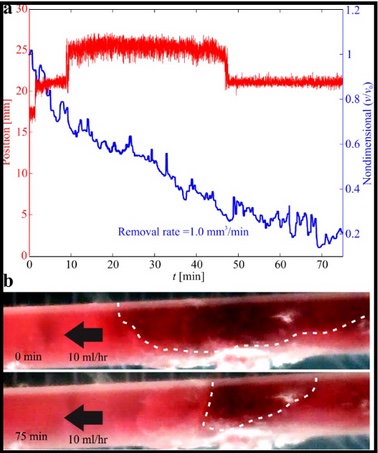
Figure 1. The removal of a blood clot over time with the assistance of a microrobot shifts the thrombus away from the middle of the blood vessel and towards the more open end.
In regard to the microrobot’s ability to physically remove a blood clot from the blood vessels, they can be manually steered through magnetic fields to push against a blood clot and move it through and out of the vessel it was originally blocking, if the clot is small enough. In other cases, where the blood clot is of the larger variety, it can be burst by the microrobots, rather than removed. This happens through the process of the helical microrobot’s tip puncturing and breaking the protein fibrin constituents of the blood clot. By breaking the fibrin structure of the clot, the thrombus (clot) begins to decompose and blood cells begin to break free, ultimately resulting in the large blood clot deteriorating within the bloodstream (Doutel et al., 2021). The microrobots can be inserted into the blood vessels in a minimally invasive way, making it a unique and important alternative method to consider when dealing with the treatment of a serious blood clot.
The capabilities of microbots are not only limited to the removal of blood clots, as targeted drug delivery is another pathway that can be explored. Most common drug delivery methods are non-targeted and generally travel throughout the body, limiting the amount of the drug that is delivered to the specific area that needs it. Microrobots can be an effective means to deliver drugs to targeted areas of the body, which would result in more effective treatments for the patient and quicker recovery times. Additionally, there are certain medicinal treatments that are prescribed to help treat a particular area of the body but can negatively affect other areas if they interact for a prolonged period of time. Through the use of targeted drug delivery techniques, such as the utilization of micro-robotic technology, these medications will be carefully delivered only to the specific areas that need them (Hu et al., 2020).
An additional potential use of microrobots that has not been explored as thoroughly but is still relevant to the discussion at hand is its possible role in identifying specific cells or regions to diagnose or treat. The use of a microrobot that is inside the body that could make these distinctions would revolutionize the scientific and medical fields, as a variety of new discoveries could be made with new foundational knowledge gained. Specific diseases and conditions could be directly and immediately treated without long testing periods to confirm which techniques are effective and accurate enough to be used.
Overall, the novel technology and techniques that helical microrobots can provide for the medical and scientific research community are unparalleled. Its contributions include a minimally invasive surgical approach to removing blood clots, a targeted method of delivering drugs within the body’s circulatory system, and the possibility of being able to identify specific cells to treat in an effective and time-efficient manner.
References
Islam, et al. “Magnetic Localization and Control of Helical Robots for Clearing Superficial Blood Clots.” APL Bioengineering, vol. 3, no. 2, 20 May 2019, https://doi.org/10.1063/1.5090872. Accessed 22 Jan. 2024.
Doutel, Erica, et al. “Hemodynamics Challenges for the Navigation of Medical Microbots for the Treatment of CVDs.” Materials, vol. 14, no. 23, 2 Dec. 2021, p. 7402, https://doi.org/10.3390/ma14237402. Accessed 10 Nov. 2022.
Ashorobi, Damilola, et al. “Thrombosis.” PubMed, StatPearls Publishing, 2020, www.ncbi.nlm.nih.gov/books/NBK538430/.
Hu, Mengyi, et al. “Micro/Nanorobot: A Promising Targeted Drug Delivery System.” Pharmaceutics, vol. 12, no. 7, 15 July 2020, p. 665, www.ncbi.nlm.nih.gov/pmc/articles/PMC7407549/.
How to cite this article
Mathew, E. (2024). Potential of Microrobots to Effectively Remove Blood Clots and Deliver Targeted Drugs. Columbia Scientist, 3, 38–40. https://columbiascientist.org/articles/microrobots-blood-clots
© 2024 Emily Mathew. This is an open-access article distributed under the terms of the Creative Commons Attribution 4.0 International licence, which permits use, distribution, and reproduction in any medium, provided the original author and source are credited.
More from Edition 3
Full table of contents →Regenerative Medicine
Bloody Breakthrough: Menstrual Blood-Derived Stem Cell TherapyGene Therapy
Whispers of Tomorrow: Gene Therapy’s Quest to Silence NeurodegenerationHealthcare and Media
Ozempic and the “Miracle Drug” Craze