Energy
LFP batteries: The Chemistry That Waited for the Right Time
A podcast on lithium iron phosphate batteries: identified in 1996, written off as impractical, and now a leader in electric cars, buses and grid storage.
- Published in
- Edition 5, Fall 2026
- Pages
- 24–26
- Licence
- CC BY 4.0
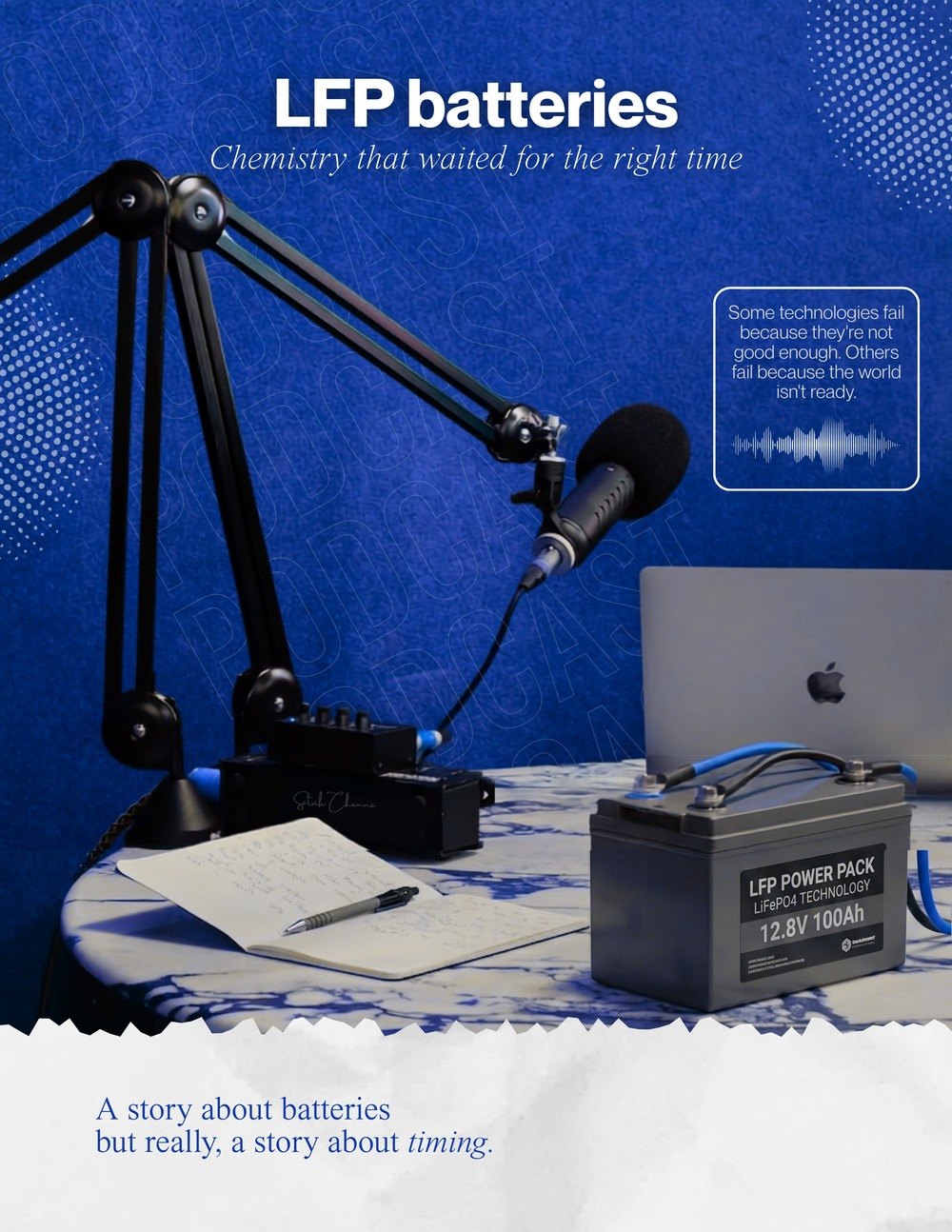
This podcast explores how Lithium Iron Phosphate (LFP) batteries, considered one of the most reliable batteries globally, rose to prominence. Lithium Iron Phosphate batteries were plagued with conductivity issues and less energy density as compared to other lithium-ion batteries. However, material innovations, patent battles, and manufacturing momentum altered their course. This podcast discusses how safety, costs, cycle life, and manufacturing scalability made LFP batteries the leaders in electric cars, public transit, and power storage. A science-based story of invention, where innovation is more about timing, practicality, and real-world adoption.
The script
Opening Hook
To understand why LFP batteries matter today, it helps to think about time, not simply as dates on a timeline, but as the slow force that determines which technologies survive and which quietly disappear.
Section 1: The Battery History Lens
The history of batteries is full of technologies that initially appeared promising but eventually faded away. What makes LFP interesting is that it did the opposite. It waited.
The story begins in 1996 at the University of Texas at Austin, where John Goodenough identified lithium iron phosphate as a potential new cathode material. Goodenough would later receive the Nobel Prize for his contributions to the development of lithium-ion batteries.
At the time, most lithium-ion batteries relied on cobalt-based chemistries. Cobalt was expensive, difficult to source, and concentrated in only a few regions around the world. LFP offered an alternative. It used iron instead, a material that was inexpensive, abundant, and non-toxic. From a materials perspective, it almost seemed too good to be true.
Section 2: The Early Failure
That early promise quickly faded. The first LFP batteries suffered from extremely poor electrical conductivity. Electrons could not move efficiently through the material, which severely limited the amount of power the batteries could deliver.
In practice, this made the early LFP cells weak and inefficient. Most engineers concluded that LFP was scientifically interesting but commercially impractical.
As a result, the wider battery industry shifted its attention toward other chemistries.
Section 3: Patents, Power, and the Legal Wall
Instead of being aggressively developed within the United States, the patents were licensed out. They eventually became part of Hydro-Québec, which helped establish an international consortium to control the intellectual property.
The consortium adopted an extremely defensive legal strategy. Any Western company attempting to manufacture LFP batteries risked paying massive royalties or becoming trapped in lengthy and expensive lawsuits.
That legal uncertainty created a major problem. Battery production requires enormous upfront investment, and few companies were willing to build billion-dollar factories around a chemistry they could not fully control.
Section 4: A123 Systems and a Breakthrough
One company still attempted to move forward. A123 Systems, an MIT spin-off led by Yet-Ming Chiang, developed a solution to the conductivity problem using carbon coatings and nanotechnology.
This marked a genuine breakthrough. For the first time, LFP batteries could operate at high power.
However, A123 outsourced manufacturing to China in order to reduce costs and remain competitive. Lawsuits from the patent consortium soon followed. Although a settlement was eventually reached in 2011, the damage had already been done.
Years of legal conflict drained investor confidence and pushed A123 into bankruptcy. In 2012, the company’s manufacturing expertise was ultimately acquired by China’s Wanxiang Group.
Section 5: The China Split
Around this time, something important changed. The patent holders realized that enforcing their intellectual property rights within China was becoming extremely difficult.
Rather than continuing the legal battle, they reached a compromise with a group of manufacturers known as the China Alliance. Under this agreement, Chinese companies could produce LFP batteries without paying royalties, as long as the batteries were sold and used within China.
That single decision created a sharp global divide. Outside China, LFP remained legally risky and expensive. Inside China, it became affordable, accessible, and increasingly attractive.
This is where time began to play its most important role.
Section 6: Scale as the Real Innovation
Throughout the 2010s, Chinese manufacturers continued producing LFP batteries at massive scale. Companies such as CATL and BYD did not treat LFP as a temporary solution. They treated it as infrastructure.
Their focus was not on dramatic scientific breakthroughs, but on refining manufacturing processes, improving consistency, and lowering costs year after year. Chinese government policy strengthened this strategy.
Domestic suppliers received battery subsidies, while major government programs excluded many foreign manufacturers. At the same time, China required a large share of its electric buses to use LFP batteries because of their safety and thermal stability.
These policies guaranteed demand. Guaranteed demand enabled scale. And scale changed everything.
As production volumes increased, costs fell dramatically. Manufacturing errors declined. Supply chains matured. Engineers gained experience.
None of this required a revolutionary scientific discovery. It required repetition.
Section 7: Why LFP Wins
While Western companies pursued higher-energy-density chemistries such as nickel manganese cobalt, Chinese manufacturers made a different bet: a battery that was cheaper, safer, and longer lasting.
This became the true innovation behind LFP. It was never the most impressive battery on a specification sheet, nor did it lead in energy density. Compared to many cobalt-based batteries, LFP stores less energy per kilogram.
For a long time, that made it appear inferior.
But batteries are not chosen in isolation. They are chosen based on their applications.
In electric buses, delivery trucks, taxis, and grid storage systems, energy density matters less than safety, lifespan, and cost.
LFP batteries can endure significantly more charge cycles. They are far less likely to catch fire. They tolerate abuse and extreme temperatures more effectively. And when manufactured at scale, they become dramatically cheaper.
Closing: The Context Changed
By the end of the 2010s, the consequences of this strategy could no longer be ignored. LFP batteries had become so inexpensive that they fundamentally changed global expectations around battery pricing.
Projects once considered financially unrealistic suddenly became possible.
At the same time, attitudes in the West began to shift. Consumers proved willing to trade maximum driving range for lower prices and greater safety.
LFP itself had not radically changed. What changed was the world around it.
As major patents began expiring globally, some as late as 2022, China had already built control over most of the LFP supply chain, from raw material processing to cathode manufacturing and final cell production. Even today, the vast majority of LFP cathode material is produced in China.
Thank you!
How to cite this article
Chenna, S. (2026). LFP batteries: The Chemistry That Waited for the Right Time. Columbia Scientist, 5, 24–26. https://columbiascientist.org/articles/lfp-batteries
© 2026 Satvik Chenna. This is an open-access article distributed under the terms of the Creative Commons Attribution 4.0 International licence, which permits use, distribution, and reproduction in any medium, provided the original author and source are credited.