Gene Therapy
First-Ever Gene Therapy For High Cholesterol: The One-Time Solution to 4 Million Annual Deaths?
A single infusion of VERVE-101 rewrites one DNA letter in the liver to switch off PCSK9, cutting stubborn LDL cholesterol by up to 73% in early trials, though safety pauses and ethics questions linger.
- Published in
- Edition 3, Winter 2024
- Pages
- 22–24
- Licence
- CC BY 4.0
In a recent presentation at the American Heart Association’s November meeting, Boston-based Verve Therapeutics introduced a novel, single-infusion treatment for dangerously high levels of cholesterol: a gene-therapy treatment known as VERVE-101. The results of the Phase 1 trials, led by Dr. Sekar Kathiresan, chief executive of Verve, support the first-ever evidence that a single DNA nucleotide in the human body can be rewritten for a significant clinical effect. Dr. Kathiresan’s study is the first human trial of VERVE-101 (Murphy).
Extremely high cholesterol levels result in early death due to cardiovascular disease, the leading cause of death in the world. 1 in every 5 deaths in the U.S. can be traced to heart disease caused by high levels of a form of cholesterol known as low-density lipoprotein (LDL) cholesterol (CDC). LDL cholesterol blocks blood to the heart and brain, narrowing arteries and thus setting optimal conditions for heart attacks and strokes.
Heterozygous familial hypercholesterolemia (HeFH) is a genetic disorder causing extremely high LDL. Altered genes can be passed down from one or both parents to be expressed in an individual. These genetic changes prevent the body from lowering the LDL cholesterol that builds up in the arteries and causes heart disease. Globally, 1 in every 250 people are affected by this disease (CDC).
While most cholesterol patients can usually take a safe and effective class of drugs known as statins, this method of reducing LDL requires patients to take medication every day, leaving them vulnerable on days they fail to take their treatment. Furthermore, these general drugs have no effect on some patients with extremely high LDL due to genetic disorders like HeFH (Stein); only 3% of patients with heterozygous familial hypercholesterolemia, globally, have reached target treatment goals (AHA).
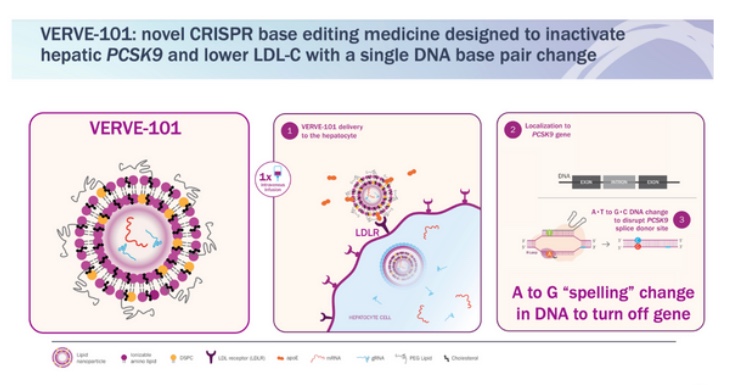
Instead of taking daily pills or intermittent injections over decades, anyone at risk from high LDL cholesterol levels could potentially benefit from Verve Therapeutics’s gene-editing treatment VERVE-101 after just one infusion. Blood LDL levels are regulated by the PCSK9 protein and the LDL-cholesterol receptors on cell membranes. LDL-cholesterol receptors on the surface of hepatocytes, or liver cells, normally decrease cholesterol levels by taking up and breaking down LDL particles from the bloodstream for intracellular use, thus decreasing cholesterol levels in the bloodstream. On the other hand, PCSK9 helps regulate LDL-cholesterol by increasing bloodstream levels; PCSK9 binds to and degrades LDL-cholesterol receptors. Hence, cholesterol intake into cells is inhibited, leading to a higher level of LDL-cholesterol left in the bloodstream. VERVE-101 is a lipid nanoparticle comprising a messenger RNA molecule and a guide RNA molecule that can recognize PCSK9 (Verve Therapeutics).
Figure 1: Overview of Verve-101 development (Verve Therapeutics, 22).
Together, this gene-editing complex can permanently turn off the PCSK9 gene in the liver through the Nobel Chemistry Prize-winning CRISPR/Cas9 genetic “scissors,” invented by biochemist Jennifer Doudna and microbiologist Emmanuelle Charpentier in 2020 (see Figure 1). Furthermore, the researchers had the power to edit liver cell genes without having to extract, edit, and reinfuse the cells back into the patient’s body, making VERVE-101 a minimally invasive treatment. In the ongoing trial, researchers are infusing different doses of CRISPR base-editing molecules that find their way to the liver to edit PCSK9.
Of the ten patients from the U.K. and New Zealand in this Phase 1 trial, 7 were men and two were women, with an average age of 54 years. Each participant was diagnosed with HeFH — they had inherited one gene for the disorder from one parent — and still had extremely high LDL cholesterol levels (average measure of 201 mg/dL) despite taking the maximum-tolerated LDL cholesterol-lowering medication. A majority of study participants also suffer from severe coronary artery disease and had experienced heart attacks, undergone coronary bypass surgery, or undergone stenting (removal of cholesterol-based plaque in blood vessels through a mesh tube), to have adequate blood flow to the heart. None had been taking PCSK9 inhibitors before the study (Stein). In April 2024, three additional patients were administered the second highest dosage of 0.45 mg/kg. Between the total of five participants in the 0.45 mg/kg cohort, VERVE-101 demonstrated up to 73% time-averaged LDL cholesterol reductions, with an overall average reduction of 46% (due to a data cut-off date on March 18, 2024). The patient with the highest-received dosage (0.6 mg/kg) experienced a 55% reduction in LDL cholesterol (ACC). In two patients from the 0.45 mg/kg and 0.6 mg/kg cohorts, LDL cholesterol lowering effects have been maintained up to 270 days in the ongoing follow-up. Participants are required to undergo a long-term follow-up study for 14 years, as required by the FDA for all participants in human genome editing trials, before VERVE-101 can attain FDA approval (Philippidis).
Amidst the celebration of having tapped into the human genome, many experts voice concern in editing the human genome without full awareness of the consequences of doing so. Albeit, further analysis indicated VERVE-101 does not induce chromosomal translocations or structural variants following treatment (Verve Therapeutics) (see Figure 2), clinical trial enrollment was put on pause on April 2, 2024, on the basis of “laboratory abnormalities,” after a patient experienced a severe drug-related adverse event (Reuters).
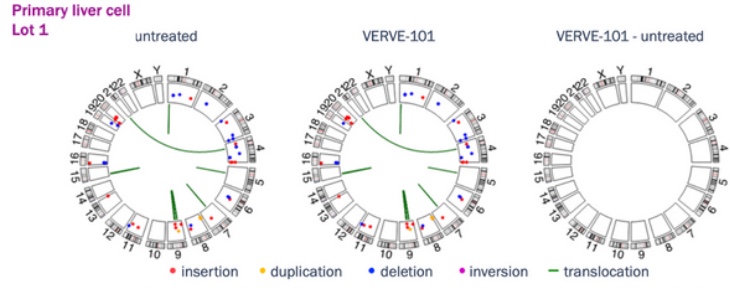
Figure 2: No chromosomal translocations or structural variants were observed after treatment of primary human liver cells with VERVE-101. (Verve Therapeutics, 33).
Researchers note that elusive and inadvertent genetic changes, known as “off-target effects”, could result in major health complications later on (Stein). Ethical problems on who would be able to afford life-saving gene-editing treatments—which cost millions of dollars per patient—also come into the picture when introducing this treatment to the public. Additionally, the use of gene editing for therapeutic reasons could give way to the use of gene therapy for non-therapeutic or enhancement purposes, which, again, could develop deeper ethical divides.
Overall, VERVE-101 has great potential as a novel, single-course gene therapy drug that can replace daily pills or intermittent injections for decades on end, preventing the death of 4.4 million patients annually suffering from high LDL cholesterol globally (WHF). As Dr. Doudna once stated, “The world stands on the edge of an era when gene editing can address many serious [and hitherto ‘incurable’] ills plaguing humankind.” With the advances of pioneering minds and organizations, such as Verve Therapeutics, humanity is only getting closer to this ultimate objective.
References
Murphy, T. (2024, January 11). Gene-editing treatment could replace cholesterol meds. Harvard Gazette.
CDC. (2023, June 16). Familial Hypercholesterolemia. cdc.gov. https://www.cdc.gov/genomics/disease/fh/FH.htm#:~:text=Familial%20hypercholesterolemia%20(FH)%20is%20a,disease%20at%20a%20younger%20age.
Stein, R. (2023, November 12). For the first time, gene-editing provides hints for lowering cholesterol. NPR. https://www.npr.org/sections/health-shots/2023/11/12/1211672034/for-the-first-time-gene-editing-provides-hints-for-lowering-cholesterol
ACC (American College of Cardiology). (2023, November 12). Verve-101: CRISPR-based gene editing therapy shows promise in reducing LDL-C and PCSK9 levels in patients with HeFH. American College of Cardiology. https://www.acc.org/Latest-in-Cardiology/Articles/2023/11/08/20/14/sun-445pm-heart1-aha-2023
AHA (American Heart Association). (2023, November 12) A Single Infusion of a Gene-Editing Medicine May Control Inherited High LDL Cholesterol. ,newsroom.heart.org/news/a-single-infusion-of-a-gene-editing-medicine-may-control-inherited-high-ldl-cholesterol#:~:text=%E2%80%9CThese%20numbers%20are%20consistent%20with,treatment%20goals%2C%E2%80%9D%20Bellinger%20said.
Verve Therapeutics. (2023, November 13). Safety and pharmacodynamic effects of verve-101. Verve Therapeutics Publications and Presentations. https://www.vervetx.com/sites/default/files/2023-11/Verve_AHA_2023_LBS_for%20website.pdf
Philippidis, A. (2023, November 14). Verve’s in vivo base editing therapy shows human proof-of-concept data. GEN. https://www.genengnews.com/topics/genome-editing/verves-in-vivo-base-editing-therapy-shows-human-proof-of-concept-data/
Reuters. (2024, April 2). Verve therapeutics pauses enrollment in early-stage gene therapy study for high cholesterol levels | Reuters. https://www.reuters.com/business/healthcare-pharmaceuticals/verve-therapeutics-pauses-enrollment-early-stage-gene-therapy-study-high-2024-04-02/
WHF. (2024, March 26). Cholesterol: What we do. World Heart Federation. https://world-heart-federation.org/what-we-do/cholesterol/#:~:text=High%20blood%20cholesterol%20is%20one,or%207.8%25%20of%20all%20deaths.
How to cite this article
Marambage, L. (2024). First-Ever Gene Therapy For High Cholesterol: The One-Time Solution to 4 Million Annual Deaths?. Columbia Scientist, 3, 22–24. https://columbiascientist.org/articles/gene-therapy-cholesterol
© 2024 Lehansa Marambage. This is an open-access article distributed under the terms of the Creative Commons Attribution 4.0 International licence, which permits use, distribution, and reproduction in any medium, provided the original author and source are credited.
More from Edition 3
Full table of contents →Regenerative Medicine
Bloody Breakthrough: Menstrual Blood-Derived Stem Cell TherapyGene Therapy
Whispers of Tomorrow: Gene Therapy’s Quest to Silence NeurodegenerationHealthcare and Media
Ozempic and the “Miracle Drug” Craze