Art & Science
Cells, Cells, Cells: The Building Blocks of Life and Art
Semi-living worry dolls grown from tissue, a map of Earth drawn in DNA, bacterial paints that react on the canvas: a tour of BioArt, where artists use living cells to ask what synthetic biology means.
- Published in
- Edition 3, Winter 2024
- Pages
- 29–31
- Licence
- CC BY 4.0
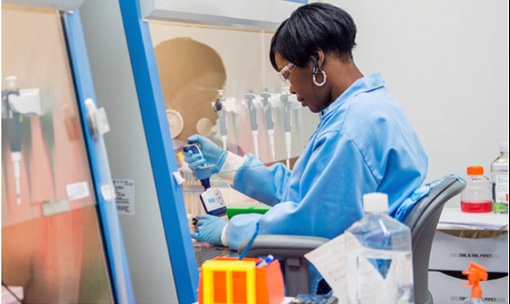
Photo by University of Pennsylvania on the Gene Therapy Process
We as humans seem to be enamored with the concept of life. People constantly think about what it means to be alive and how to best use our own lives. It shows up everywhere, in our conversations, our classes, but especially in our art. Artists are constantly using the living world as inspiration, from the sculptures of ancient Egypt to the paintings of Claude Monet. But what if we could paint with life itself? That’s the reality of artists all over the world – developing innovative and peculiar works of art from cells, proteins, and living tissue. Pushing the boundaries of artistic expression, their works often explore the complexity of life. These people form a diverse bunch, making up a category commonly referred to as “BioArt”.
What is “BioArt”?
At its core, “Bioart” is defined as the use of biological materials or processes to create a work of art. In this way, Bioart isn’t a genre with a set theme like abstract or surreal, but instead a name for the countless works made with tools pioneered by science. One popular tool is cell or tissue engineering. Cells are the smallest unit of any organism while tissues are collections of similar cells that work together. The process of growing tissue involves cells being placed into an incubator, a heating device which maintains the best temperature for cell growth.
By growing their medium in a lab, artists can manipulate tiny living things to look or behave a certain way. An artist can introduce certain proteins to get a specific shape or color. They may try to alter the behavior of the cell, making an easily weakened cell more resilient. It’s no different from when a painter mixes distinct shades to get that perfect hue. However, the nature of BioArt means no artist gets full control over the final outcome. Bacterium, or single-celled microorganisms, are another material often used. Different bacterial paints can communicate with each other, causing chemical reactions and influencing the final painting in a way that is complex and difficult to predict (Frankel et al., 2023). A consistent look is sacrificed for artistic expression. For artists, the goal is to have a creation whose very existence prompts deeper thought.
What are some examples of “BioArt”?
One such artist is Oron Catts, director of SymbioticA, a research lab at the University of Western Australia, and co-founder of the Tissue Culture and Art Project. The scientists here began by growing different tissues on glass and then transitioned over to more sophisticated biomaterials, in the words of Catts himself.
SymbioticA’s Worry Dolls, developed in the year 2000, were the first sculptures built from live tissues from the lab. These “semi-living” dolls were inspired by Guatemalan dolls which are believed to absorb the worries of their owner. Each doll represents a different worry about the impact of biotechnology. Doll B represents worry about biotechnology and the forces that drive it, while Doll E represents worry about eugenics. Moreover, Doll H (seen below) represents worry about hope and unintended consequences that result from those who have it (Catts et al. 2001). Catts was surprised by the public’s response to the work. Initially, he thought that the work would basically trigger people to think about humanity’s relationship to life, about biotechnology, only to realize that many people use the dolls to express their most intimate concerns (Catts, 2023).
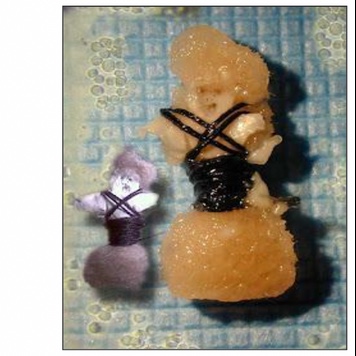
Photo by Tissue Culture & Art(ificial) Wombs Installation on Semi-Living Worry Doll H
The SymbioticA lab has given birth to many other bio artists, each with different contributions to this emerging genre. Paul Vanouse, a past student of SymbioticA, worked with gel electrophoresis. This is a procedure used to separate different strands of DNA by their sizes, like a stream with many nets placed across it. Smaller fish will pass through the nets easily, while larger fish will have a harder time getting through the nets and travel more slowly. This process ends up creating DNA rings of varying sizes inside the gel. Vanouse used that process to create a map of planet Earth. By developing a circular container for the materials and picking DNA strands of certain sizes, he was able to control how far the genetic material traveled through the gel, shaping his desired outcome.
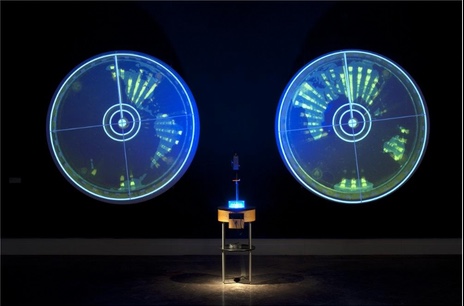
Photo by Paul Vanouse on Ocular Revision
What is the goal of BioArt?
A constant in BioArt is an artistic appreciation for the concept of life, how it can be manipulated by human forces. Synthetic biology, the wider field it falls under, works to combine the principles of engineering with biological systems. Redesigning organisms so that they produce a substance, such as medicine or fuel, or gain a new ability, are common goals of synthetic biology projects (National Human Genome Research Institute, 2019). The industry tends to focus on what exactly a group of altered cells can do. Artists, on the other hand, are more concerned with asking questions about what synthetic biology means, than engaging with the idea of “usefulness”. In the words of Oron Catts, “ … the idea of growing fragments of bodies, without ever intending to reproduce them into bodies, was something that was of interest for me, it raised the right questions” (Catts, 2023). Artist Anna Dumitru, who works to combine microbiology with antique objects and crafting techniques, takes a more assertive stance. She declares that she is not interested in justifying the contribution of art as research in the present academic setting, which aims to monetize impact (Thomas, 2013). The contribution of art is art itself.
This stance is not necessarily shared by the wider scientific community. Lack of institutional support, lack of financial support from the federal and private sectors, and lack of access to equipment all prevent BioArt from expanding as an interdisciplinary field (Jagodzinski, 2020).
In the early years of SymbioticA, Catts developed the program without getting paid by the University of Western Australia. Catts recognized it was important to push the idea that this type of artistic research is as valid as scientific research, that everyone should have similar rights to have access to those resources (Catts, 2023).
Why should you care about BioArt?
Society needs artists. There need to be individuals that are critiquing the violent, even unethical nature of synthetic biology by exploring it. For Catts, it was never about the perfect piece, but about problematizing humanity’s newfound powers over life. This sentiment seems to ring true for many. Next time you are in a lab or a museum, think about the value of science, art, and life. All three are inherently connected.
References
Catts, O., Zurr, I., & Ben-Ary, G. (2001). Worry Dolls. The Tissue Culture & Art Project. https://tcaproject.net/portfolio/worry-dolls/
Catts, O. (2023). Recorded personal interview with Director of SymbioticA Lab. July 17, 2023. Zoom Online Conferencing Platform.
Frankel, E., Temple, J., Dikener, E., & Berkmen, M. (2023). Bridging the gap with bacterial art. FEMS Microbiology Letters, 370. https://doi.org/10.1093/femsle/fnad025
Jagodzinski, J. (2020). Thinking ‘the end of times’: The significance of bioart|bioart for art|education. Pedagogical Explorations in a Posthuman Age, 271–291. https://doi.org/10.1007/978-3-030-48618-1_11
National Human Genome Research Institute. (2019, August 14). Synthetic Biology. Genome.gov. https://www.genome.gov/about-genomics/policy-issues/Synthetic-Biology#:~:text=Synthetic%20biology%20is%20a%20field,them%20to%20have%20new%20abilities .
Thomas, L. (2013, January 18). Interview with Anna Dumitriu. 4Humanities. https://4humanities.org/2013/01/dumitriu-interview/
How to cite this article
Emy-Munonye, C. (2024). Cells, Cells, Cells: The Building Blocks of Life and Art. Columbia Scientist, 3, 29–31. https://columbiascientist.org/articles/cells-building-blocks-bioart
© 2024 Chidalu Emy-Munonye. This is an open-access article distributed under the terms of the Creative Commons Attribution 4.0 International licence, which permits use, distribution, and reproduction in any medium, provided the original author and source are credited.
More from Edition 3
Full table of contents →Regenerative Medicine
Bloody Breakthrough: Menstrual Blood-Derived Stem Cell TherapyGene Therapy
Whispers of Tomorrow: Gene Therapy’s Quest to Silence NeurodegenerationHealthcare and Media
Ozempic and the “Miracle Drug” Craze